

Business Operation · 2025
In this section23 topics
- Corporate Information4 items
- Dividend Policy2 items
- Major Shareholders1 item
- Business Strategies Overview6 items
- Material Changes & Developments2 items
- Use of Proceeds from Securities Offerings3 items
- Commitments Made in the Registration Statement1 item
- Group Operating-Structure Policy1 item
- Companies Where the Company Holds ≥10%1 item
- Shareholders with Potential Conflict of Interest1 item
- Relationships Among Major Shareholders2 items
- Shareholders' Agreement2 items
- Shareholding Diagram (Group Structure)2 items
- Income Structure4 items
- Product / Service Characteristics2 items
- Research & Development2 items
- Assets Used in the Business5 items
- Marketing Policy & Competition3 items
- Procurement of Products & Services8 items
- Product Information — Overview1 item
- Projects Under Construction1 item
- Debentures & Bills of Exchange1 item
- Convertible Securities1 item
Corporate Information
Company Name
Atlas Energy Public Company Limited
Telephone
08-0059-7044
Website
www.atlasenergy.co.th
ptgas@atlasenergy.co.th
Dividend Policy
Dividend Policy
The Company’s policy is to distribute dividends to shareholders at a rate of no less than 30% of net profit from the separate financial statements, after deducting corporate income tax and the required statutory reserves. However, the dividend payout may be adjusted based on factors such as the economic environment, the Company's cash flow, its investment plans, and other circumstances deemed appropriate by the Board of Directors. The annual dividend payment must be approved by the shareholders’ meeting, unless it is an interim dividend. In such cases, the Board of Directors may approve the interim dividend payment if the Company has sufficient profits, and the interim dividend payment will be reported to the shareholders at the next meeting.
Historical Dividend Payments
| This Year | Last Year | 2 Years Ago | 3 Years Ago | 4 Years Ago | Metric | Description | Remark |
|---|---|---|---|---|---|---|---|
| 301,109,207 | 285,238,204 | 232,437,084 | 314,233,564 | 50,116,133 | Net profit per share (Baht : Share) | Net profit per share (baht : share) | |
| 0.1 | 0 | 0 | 0 | 0 | Dividend per share (Baht : Share) | Dividend per share (baht : share) | |
| 0 | 0 | 0 | 0 | 0 | Dividend stock ratio (Number of original shares: dividend shares) | Ratio of stock dividend payment (existing share : stock dividend) | |
| 0 | 0 | 0 | 0 | 0 | Dividend share value per share (Baht : Share) | Value of stock dividend per share (baht : share) | |
| 0.15 | 0 | 0 | 0 | 0 | Total dividend payment value (Baht : Share) | Total dividend payment (baht : share) | |
| 70.66 | 0 | 0 | 0 | 0 | Dividend payout ratio to net profit (%) | Dividend payout ratio compared to net profit (%) | |
| 0.05 | 0 | 0 | 0 | 0 | Dividend per share | The meeting resolved to approve the dividend payment from the operating results for the period from 1 January 2025 to 31 December 2025 at the rate of THB 0.15 per share for 1,418.42 million ordinary shares, totaling 212.76 MB:
- An interim dividend from the operating results for the period from 1 January 2025 to 31 October 2025 at the rate of THB 0.10 per share, for 1,418.42 million ordinary shares, totaling 141.84 MB. The dividend was paid on 3 December 2025.
- After the payment of the interim dividend for the ten-month period ended 31 October 2025, the remaining dividend of THB 0.05 per share, totaling 70.92 MB, will be paid on 22 May 2026.
|
Business Strategies Overview
Chairman's Message
Dear Shareholders and Stakeholders,
The year 2025 marked a year of opportunity and a significant milestone for Atlas Energy Public Company Limited (ATLAS) in being listed on the Stock Exchange of Thailand (SET), which reflects the Company’s operational readiness, long-term growth potential, as well as the confidence of shareholders and stakeholders across all parties.
Leading the LPG Business While Driving a Sustainable Ecosystem
I strongly believe that ATLAS Energy possesses a capable and dedicated team ready to drive the organization toward stable and sustainable growth, built upon strong operational foundations while adhering to principles of good corporate governance and social responsibility.
ATLAS Energy is a leader in the distribution of liquefied petroleum gas (LPG) with a core business model focused on owning and directly managing its operations. This enables the Company to control safety standards and service quality, and also creates revenue that is recurring and stable. As of the end of 2025, the Company operated 698 service stations, comprising 181 service stations offering both LPG and oil (mixed stations), 64 LPG stand alone service stations (LPG stations), and 453 gas shops, all designed to serve customers under the concept of “Creative Energy Retail”.
Alongside its core operations, the Company has expanded into Non-LPG businesses, including the oil management services businesses for PTG Energy Public Company Limited (PTG), which creates synergy within the business group, including the development of an ecosystem within the service stations to be more comprehensive.
Strengthening Good Corporate Governance for Value and Sustainability in All Dimensions
Amid the changes in the global economy, which is experiencing volatility from geopolitical conflicts as well as climate change, the Company continues to conduct its business under the principles of good governance by emphasizing strong, transparent, and responsible corporate governance, together with compliance with laws, prudent risk management, and effective internal control in order to build long-term stability and confidence among stakeholders from all sectors. In this regard, the Company operates its business under the ESG framework, with governance as the central dimension, while promoting an organizational culture that upholds integrity, responsibility, fairness, and accurate and transparent disclosure of information.
Driving Sustainable Growth under Differentiated Strategies and Fair Competition
The Company recognizes the importance of all stakeholders throughout the supply chain from upstream to downstream operations. We are committed to creating value through our products and services to meet stakeholder expectations while driving sustainable growth across economic, social, and environmental dimensions. Our operations cover 5 key activities, including procurement, transportation, storage, operations, as well as marketing and services, all of which are systematically interconnected under standards of quality, safety, and friendliness to the environment and neighboring communities.
The Company selects partners and service providers with standards, reliability, and modern technologies in storage and operational processes, while continuously developing our personnel to deliver high-quality, efficient, and safe products and services to customers. The Company aims to create differentiation through standardized services, expanding networks and distribution channels to reach customers comprehensively, and responding to the needs of customers in all groups. All of these are the important foundation of sustainable growth, on a fair competitive field, and the creation of long-term value.
To strengthen and reinforce our leadership in LPG distribution through presenting differentiation with Alumax technology gas cylinders, which are lightweight, durable, and manufactured through a seamless forming process that enhances safety and reduces the risk of leakage. This advantage reflects our understanding of consumer needs and our commitment to raising the standards of the Company’s products and services.
We will continue to drive its LPG business under the “Hub & Spoke” strategy to expand service coverage and improve logistics and distribution efficiency, alongside the continued development of the advertising services business mentioned above.
For the advertising media business, the Company has initiated strategic initiatives to enhance the utilization of existing assets through Asset Monetization, creating additional sustainable revenue streams.
Fostering Sustainability: Contributing to a harmonious society and growing together
I firmly believe that all stakeholders including shareholders, customers, partners, suppliers, and our employees should enjoy a good quality of life and genuine well-being.
Under our corporate governance framework, it collaborated with the Thai Red Cross Society (TRCS) and Waste Buy Delivery by installing waste separation bins at 23 PT LPG service stations across Bangkok and surrounding areas and donated the revenue from the sale of recyclable waste to the TRCS in order to support assistance for disaster victims.
At the same time, the Company has adopted environmentally responsible management practices by installing Solar Rooftop systems at service stations and utilizing electric motorcycles for delivery services to customers to enhance energy efficiency, reduce greenhouse gas emissions and carbon footprints, together with managing operating costs appropriately. This reflects the efficient use of resources and supports the long-term sustainable growth of the organization, including continuous participation in addressing climate change.
On behalf of the Chairman of the Board Director, I would like to express my sincere appreciation to our shareholders, investors, customers, business partners, stakeholders, and all parties involved for supporting the Company’s operations, enabling the Company to achieve its business objectives in creating sustainable value for shareholders and stakeholders in all sectors, and to drive the organization toward stable and sustainable success going forward.
Vision
The innovation pioneer in products and services that bring happiness to every household unit.
Objectives
Delivering energy that is valuable and safe through excellent service standards, to enhance happiness and elevate the well-being for all.
Goals
-
Business Strategies
The Company aims to expand access to its LPG products nationwide. To achieve this objective, the Company has established the following operational goals and strategies:
1. Continuous Expansion of Production Capacity
To meet both current and future demand for liquefied petroleum gas (“LPG”) in the household sector (“Cooking Gas”), the Company has continuously invested in expanding its LPG filling plant network. Since commencing operations of its first filling plant in 2020, the Company has progressively established additional Filling plants in strategic locations across Thailand and enhanced the efficiency of existing facilities through system upgrades and semi-automation.
As of 2025, the Company operates multiple LPG Filling plants with a combined maximum filling capacity of approximately 11,750 tons per month. The Company has also appointed qualified operators as contractors to operate LPG Filling plants to enhance production capacity and expand distribution coverage nationwide.
2. Expansion of Distribution Channels Across All Customer Segments
The Company aims to expand LPG distribution channels across all sectors, including the household, automotive, and industrial sectors, in order to comprehensively serve the LPG consumption needs of customers nationwide.
For the household sector, the Company has continuously expanded its network of COCO Gas shops. The Company primarily leases area within oil service stations operated by Petroleum Thai Corporation Co., Ltd. (“PTC”) to establish the COCO Gas shops. As PTC service stations are widely available and located nationwide, this strategy enables the Company to rapidly expand the number of its Gas shops. In addition, the Company’s LPG cylinders are marketed under the “PT” trademark, which is the same trademark used by PTC oil service stations. Accordingly, the establishment of the COCO Gas shops within PTC service stations enables the Company to reach a larger group of consumers who are already familiar with and have confidence in products under the “PT” brand, thereby facilitating faster expansion of the Company’s customer base.
In addition to expanding distribution channels through the establishment of additional Gas shops, the Company also recruits entrepreneurs who wish to distribute the Company’s LPG cylinders and appoints such entrepreneurs as the Company’s distributors (“DODO Gas shops”). This allows the Company to further expand its distribution coverage across various areas. Furthermore, the appointment of additional LPG filling plant distributors in recent periods has enabled each filling plant distributor to fill and distribute the Company’s LPG cylinders to nearby general LPG retail shops, thereby increasing the distribution of the Company’s LPG cylinders to household consumers.
With respect to the automotive sector, the Company has also continuously invested in LPG service stations in order to expand distribution channels to consumers. The Company primarily leases service stations that are currently in operation or have previously been in operation from their owners and undertakes renovation and repair works prior to reopening them as the Company’s LPG service stations. In general, renovating existing service stations requires less time than constructing new stations, enabling the Company to increase the number of its LPG service stations more rapidly. In addition, the Company seeks operators of LPG service stations who wish to use the “PT” trademark in the distribution of LPG, and appoints such operators as the Company’s distributors (“DODO Service Stations”), thereby increasing LPG distribution channels in the automotive sector.
Furthermore, in order to expand its access to customers in the industrial sector, the Company assigns its Sales Representatives to identify and approach operators who require LPG as fuel for production processes and operations within industrial factories, and to offer the Company’s LPG products to such operators.
3. Customer Relationship Management and Marketing Activities
The Company places importance on customer relationship management (Customer Relationship Management: CRM) and the implementation of sales promotion and marketing activities that are aligned with customer needs in order to enhance customer satisfaction in purchasing the Company’s products. This encourages repeat purchases from existing customers and attracts potential new customers to develop interest in and decide to purchase the Company’s products. In order to strengthen relationships with customers, the Company has participated as a merchant in the loyalty membership program of PTG, known as the Max Card program (“Max Card Loyalty Program”). Through this program, the Company is able to conduct sales promotion activities for members of the Max Card Loyalty Program (“Max Card Members”) who purchase products from the Company and OLP (collectively referred to as the “Group of Companies”). Such activities include a points accumulation and redemption program, whereby Max Card Members earn reward points when purchasing products from the Group of Companies in accordance with specified conditions (for example, points earned based on the volume of LPG refueled at LPG service stations or the purchase of LPG cylinders). Max Card Members may redeem their accumulated points for benefits in accordance with specified conditions (for example, cash discounts for product purchases). Through such points accumulation and redemption activities, the Company is able to manage customer relationships (CRM) effectively by encouraging customers to continue purchasing the Company’s products in order to accumulate points, as well as to increase their purchases in order to utilize the benefits obtained from redeeming such points. Accordingly, participation in the Max Card Loyalty Program enables the Company to strengthen its relationships with customers through sales promotion activities that are aligned with customer needs, thereby increasing the likelihood of continued purchases of the Company’s products.
Participation in the Max Card Loyalty Program enables the Company to avoid the need to develop a loyalty system entirely on its own, thereby reducing both development costs and the time required to implement such a system. In addition, participation in the Max Card Loyalty Program provides the Company with greater opportunities to expand its customer base. As the Max Card Loyalty Program has been in operation for a considerable period of time, it has accumulated a large number of members. A majority of these members are already familiar with and regularly purchase products under the “PT” trademark. This helps facilitate greater acceptance of the Company’s products among Max Card Members. Furthermore, the participation of various merchants—other than those operated by the Group of Companies and the PTG Group—in the Max Card Loyalty Program enables Max Card Members (including the Company’s customers who are Max Card Members) to enjoy a wider variety of benefits available under the program.
The Company also conducts targeted sales promotion activities aimed at encouraging specific customer groups to continuously purchase the Company’s products. For example, the Company has implemented the “PT Taxi Transform” program to support drivers of public taxis (“Taxi Drivers”) in converting taxis that currently use natural gas for vehicles (NGV) as fuel to vehicles equipped to use LPG as an alternative fuel. In addition, the Company has implemented the “PT Auto Transform” program to encourage drivers of gasoline-powered vehicles to install equipment that enables their vehicles to use LPG as fuel. For vehicles participating in the PT Taxi Transform and PT Auto Transform programs, the Company provides benefits in the form of fuel discounts for LPG refueling at PT service stations. The implementation of such programs increases the opportunity for the Company to develop a larger base of regular customers who continuously refuel LPG at the Company’s service stations.
Furthermore, the Company organizes various marketing activities across a wider range of locations in order to increase awareness of the Company’s products and to expand sales opportunities. For example, the Company conducts promotional activities for its LPG cylinders in various markets to introduce the Company’s products to food vendors and other merchants operating in such markets.
Other Information
| Name | Description |
|---|---|
| Competitive Advantage | Based on the business strategies implemented over recent years, the Company believes that it possesses the following key competitive advantages: 1. Investment in Company-Operated LPG Filling plants, Gas shops, and LPG Stations Enables Effective Operational Control The Company places strong emphasis on delivering high-quality products and providing reliable customer service. Historically, the Company has primarily invested in and operated its own LPG Filling plants, Gas shops, and LPG stations. The Company believes that direct management enables effective control and oversight of operations and service quality in accordance with the Company’s established standards. Managing LPG Filling plants internally enables the Company to appropriately determine and control each stage of the LPG cylinder filling process. This allows the Company to ensure that the LPG cylinders distributed to customers are of high quality and meet applicable standards. Such operations cover the entire process, including the procurement of LPG with appropriate quality and specifications, the inspection of LPG cylinders and valves both before and after the filling process, and the verification of the weight of LPG filled in each cylinder to ensure accuracy and completeness. Similarly, direct operation of Gas shops and LPG service stations enables the Company to define and maintain consistent customer service standards. As a result, the Company is confident that customer service at each location meets the Company’s requirements and effectively addresses customer needs. Employees at the COCO Gas shops and LPG service stations are required to undergo training programs prescribed by the Company. These programs cover operational safety (such as the transportation of LPG cylinders to customers’ premises, installation of LPG cylinders and related equipment, and LPG and fuel dispensing at refueling stations) as well as product knowledge and current promotional information, enabling staff to provide accurate guidance to customers. Employees are also required to regularly inspect operational equipment to ensure readiness and safety in service delivery. In addition, direct management of Gas shops and LPG service stations allows the Company to implement uniform promotional campaigns across its network, ensuring that customers receive consistent discounts and benefits. The Company is also able to standardize the layout and design of its Gas shops and LPG service stations and continuously 2. Application of Technology to Enhance Customer Communication and Convenience Through its long-standing experience in the LPG distribution business, the Company has gained insight into the challenges and limitations faced by LPG users across different segments. For household LPG users, one key inconvenience is the limited communication channels available for ordering LPG cylinders. Traditionally, customers are able to place orders only via telephone numbers assigned by individual Gas shops. If such numbers are unavailable or unanswered, customers may be unable to place orders in a timely manner. In addition, when customers switch to a different Gas shop, they are required to use a new contact number, which may further reduce convenience. To address these issues and enhance customer convenience, the Company has established multiple communication channels. Each Company-operated Gas shop is assigned a dedicated telephone number, allowing customers to contact specific Gas shops directly. In addition, the Company operates a centralized customer service center (Call Center), through which customers can make inquiries, submit requests, and place LPG cylinder orders. Customers who are unable to reach a specific Gas shop or are unsure which Gas shop is closest to their location can place orders through the Call Center by providing relevant information, such as customer name, delivery address, and desired LPG cylinder size. The Call Center then coordinates with the appropriate Company-operated Gas shop located nearest to the delivery location and having sufficient inventory to fulfill the order. Furthermore, the Company has developed a mobile application, “PT Max Gas,” as an additional ordering channel for LPG cylinders. Through the application, customers can select the desired LPG cylinder size, specify delivery locations, and independently choose applicable promotional offers. Upon successful order placement, the system automatically transmits the order details to the nearest Company-operated Gas shop with available inventory for delivery. Customers may also review their historical order records through the application. |
Material Changes & Developments
Introduction
Atlas Energy Public Company Limited ("the Company" or "ATLAS") was incorporated on November 23, 2011, under the name Atlas Oil Company Limited, with PTG Energy Public Company Limited ("PTG") as its major shareholder, holding 99.97% of the registered capital. Olympus Oil Company Limited ("OLP") was incorporated on September 4, 2012, with PTG as its major shareholder, holding 99.97% of the registered capital. Both the Company and OLP were established with the aim of engaging in the sale of oil, making them wholesale fuel traders under Section 10 of the Petroleum Fuel Trading Act, B.E. 2543 (A.D. 2000), ("Traders under Section 10"). Subsequently, PTG identified the demand for LPG at its service stations, branded with the "PT" trademark ("PT Service Stations"), to cater to LPG-powered vehicle users. As a result, Petroleum Thai Corporation Limited ("PTC"), a subsidiary of PTG engaged in fuel distribution at PT Service Stations, opened its first LPG service station in 2015. PTC continued expanding its LPG service stations, and by 2017, PTC introduced service stations that provide both LPG and fuel oil (“LPG stations with fuel oil sales”) to better meet the needs of users using LPG-powered vehicles. Since LPG vehicles require both LPG and fuel oil, this new service offering provides added convenience for customers who can refuel both at the same station. As a result, the demand for LPG in vehicles and the ability of LPG service stations to cater to the needs of these vehicle owners has led to a continuous increase in the number of PT LPG service stations over this period. In 2019, PTG recognized the growing demand for LPG and found an opportunity to expand into the household and industrial sectors. As a result, PTG restructured its operations, designating the Company and OLP ("the Group") as the primary entities for LPG distribution, preparing for future business growth. This restructuring clarified the operational and management structure. As part of this change, OLP transitioned from being a Section 10 Fuel Trader to a Section 11 Fuel Trader under the Petroleum Fuel Trading Act, B.E. 2543 (A.D. 2000), ("Traders under Section 11"), focusing on LPG distribution at PT Service Stations. At that time, since PTC’s gas service stations were leased from the property owner, OLP, the Company subleased those stations from PTC to continue operations. The sublease rate was set equal to the rental rate that PTC was obligated to pay to the property owner, with a sublease term of 3 years. PTC also agreed to allow OLP to continue subleasing the stations until the expiration of the original lease agreement between PTC and the property owner. (The longest lease term for gas service stations that PTC has with the property owner is set to expire in 2049.) This business restructuring resulted in the transfer of operations for 136 gas service stations from PTC to OLP in the second half of 2019. The remaining 6 stations were transferred to OLP by the end of 2021. As a result, PTC no longer operates any LPG service stations. (Further details regarding the risks associated with the Company’s sublease of gas service stations from PTC for 3-year terms, please refer to Section 1. Business Operations and Operating Results, Item 2. Risk Management, under Section 2.2.1 Risks Related to the Company’s Business and Operations, Subsection 4) Risk from subleasing LPG service stations with short lease terms.) Additionally, PTG restructured its shareholding in the Company and OLP to facilitate fundraising for the expansion of its LPG distribution business, which included securing loans from financial institutions and launching a public offering of shares. In December 2019, the Company acquired common shares in OLP from PTG, making the Company the largest shareholder in OLP, holding 75% of its registered capital, while PTG retained a 25% stake. In September 2020, the Company purchased the remaining shares in OLP from PTG, resulting in the Company owning 100% of OLP's registered capital. In 2020, the Company began its LPG distribution business for the household sector by launching its first LPG bottling plant, which it directly manages ("the Company’s LPG Filling Plant"), located at Suksawat 26, Rat Burana District, Bangkok. The facility produces LPG for filling “PT-branded” cylinders, which are then sold through the Company's Gas shops ("COCO Gas shops") in Bangkok and its vicinity. This transition to LPG distribution marked a shift for the Company from being a Section 10 Fuel Trader focused on fuel distribution to a Section 7 Fuel Trader focused on LPG distribution. Subsequently, the Company identified and partnered with operators interested in distributing its LPG cylinders, appointing them as dealers for both Filling plants and gas shops. This expanded the Company’s reach, ensuring a broader coverage for its LPG distribution network across various regions. Additionally, the Company began supplying LPG to a range of industrial factories.
Material Changes & Developments
| Year | Description |
|---|---|
| 2,011 |
|
| 2,012 |
|
| 2,015 |
|
| 2,019 |
|
| 2,020 |
|
| 2,021 |
|
| 2,022 |
|
| 2,023 |
|
| 2,024 |
|
| 2,025 |
|
Use of Proceeds from Securities Offerings
Is There Money Raised from a Securities Offering Still to Report On?
Yes
Offerings
| Type of Securities | Amount Raised Given As | Amount Raised (Million Baht) | Uses of the Money | Used as Declared? | Progress / Reasons and Measures if Not Used as Declared | Related Link |
|---|---|---|---|---|---|---|
| Equity Instruments | 2873 | 1,199.3 | 2026-12 · Objective: 1.1) Investment to increase LPG Filling plants and LPG Gas shops to support the growth of the household LPG distribution business · Period type: 2870 · Start period: 2025-10 · Spent amount type: 2873 · Start spent amount: 97.8 · Expected amount type: 2873 · Start expected amount range: 99.9 · 2026-12 · Objective: 1.2) Investment to increase LPG cylinders to support the growth of the household LPG distribution business · Period type: 2870 · Start period: 2025-10 · Spent amount type: 2873 · Start spent amount: 78.2 · Expected amount type: 2873 · Start expected amount range: 162.2 · 2026-12 · Objective: 1.3) Investment to increase LPG service stations to support the growth of the transportation LPG distribution business · Period type: 2870 · Start period: 2025-10 · Spent amount type: 2873 · Start spent amount: 222.2 · Expected amount type: 2873 · Start expected amount range: 241.6 · 2025-12 · Objective: 2.1) Investment in the “PT Auto Transform” project to increase the number of vehicles using LPG as fuel · Period type: 2870 · Start period: 2025-10 · Spent amount type: 2873 · Start spent amount: 55.5 · Expected amount type: 2873 · Start expected amount range: 69.3 · 2025-12 · Objective: 2.2) Investment to expand the industrial and commercial customer base · Period type: 2870 · Start period: 2025-10 · Spent amount type: 2873 · Start spent amount: 2.9 · Expected amount type: 2873 · Start expected amount range: 5.6 · 2025-12 · Objective: 3) Investment in businesses related to the LPG distribution business · Period type: 2870 · Start period: 2025-10 · Spent amount type: 2873 · Start spent amount: 5.1 · Expected amount type: 2873 · Start expected amount range: 400.0 · 2025-12 · Objective: 4) Use as working capital for the Company’s business operations · Period type: 2870 · Start period: 2025-10 · Spent amount type: 2873 · Start spent amount: 220.7 · Expected amount type: 2873 · Start expected amount range: 220.7 | Y | The aforementioned amounts are based on the Company’s business operation plans and estimates of its investment plans as of the date of this document and represent the best estimates for the allocation of the net proceeds expected to be received from this issuance and offering of securities. The Company may allocate the net proceeds from this offering differently from the above estimates, as the Company’s management may consider it necessary or appropriate to reallocate the net proceeds for the above purposes, or as the Company’s business operation plans, investment plans, and actual expenses in the future may differ from those at present. Accordingly, the actual use of proceeds in the future may differ from the above estimates, and the Company may use its discretion to utilize the proceeds from this offering of newly issued ordinary shares for purposes other than those specified, as appropriate. In addition, the final number of newly issued ordinary shares offered may be lower than the maximum number disclosed in this document, which may result in the Company receiving proceeds lower than the above estimates. Therefore, the actual use of proceeds in the future may differ from the above estimates, and the Company may need to allocate the proceeds from this offering differently from the above estimates. The Company believes that such circumstances will not materially affect its business operation and investment plans. If there is any change in the objectives of use of proceeds as stated in the table above, the Company will comply with the Notification of the Securities and Exchange Commission No. SorJor. 63/2561 regarding the change in objectives of use of proceeds as disclosed in the Registration Statement and Draft Prospectus. In addition, in making investments in assets and businesses, including those stated in the table above, the Company will comply with the Notification of the Capital Market Supervisory Board No. TorJor. 20/2551 regarding the rules on material transactions constituting the acquisition or disposal of assets, as well as relevant regulations of the Securities and Exchange Commission and the Stock Exchange of Thailand. The Company remains deeply grateful for your continued trust and consideration. | https://weblink.set.or.th/dat/news/202601/2024NWS300120262015312610E.pdf?_gl=1*1i1n36a*_gcl_au*MjgzNjI3NjcwLjE3NjY0ODU0NDE.*_ga*NDEzOTM3ODMzLjE3NjY0NjkzOTU.*_ga_ET2H60H2CB*czE3NzM3MTg0MzEkbzE1NSRnMSR0MTc3MzcxODQ1NyRqMzQkbDAkaDA. |
Law Governing the Debt Securities
-
Commitments Made in the Registration Statement
Are There Commitments or Conditions from an Offering or Listing?
No
Group Operating-Structure Policy
Description
PTG, the Company’s major shareholder, holds 100.00% of the Company’s registered capital. The PTG Group is primarily involved in the fuel and energy distribution business, as well as other related activities. PTG has organized its operations into 8 distinct business groups, with the Group responsible for LPG distribution being one of these key sectors.
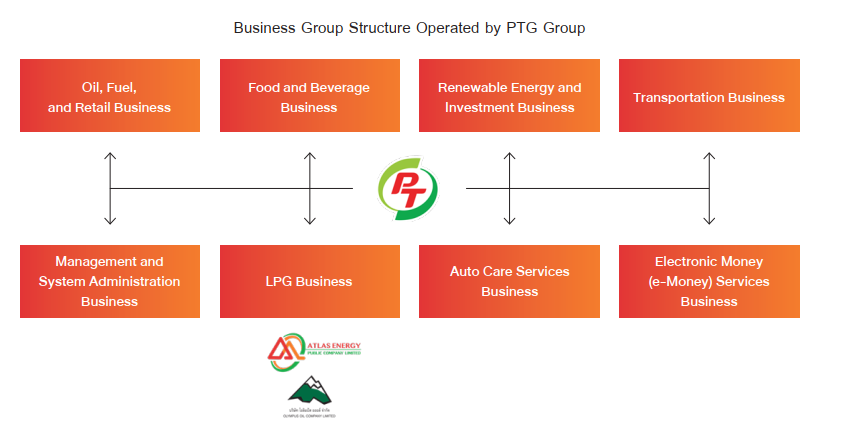
The Group purchases products and utilizes services from PTG Group for its business operations, while PTG Group also purchases products and uses services from the Group for its business activities. Key transactions between the Group and PTG Group include:
Management services for the oil retail operations at service stations.
Use of the "PT" trademark in the LPG distribution business.
Leasing of LPG Tank Trucks and vehicles for transporting bottled LPG.
Rental and sublease of gas service stations.
Participation in the Max Card loyalty program.
These intercompany transactions provide significant benefits to both the Group and the PTG Group. For example, the use of the “PT” trademark in the LPG distribution business allows the Group's products to be more widely recognized by consumers familiar with the established “PT” brand. On the other hand, PTG not only receives compensation for the use of its trademark by the Group but also benefits from enhanced brand recognition due to the variety of products associated with the “PT” trademark. This increased visibility could potentially enhance the future value of the “PT” brand. Moreover, the participation in the Max Card loyalty program enables the Group to run promotional campaigns that encourage repeat business from customers, without the need to create and manage a separate loyalty system. At the same time, the PTG Group benefits from the wide range of stores participating in the Max Card program, which helps foster higher customer satisfaction and loyalty. This broad network also increases the likelihood of attracting new members to the Max Card program. The Audit Committee and the Board of Directors have carefully reviewed the reasons for these transactions, their necessity, and their overall reasonableness. (Further details regarding intercompany transactions and the review process can be found in Section 2. Corporate Governance Item 9. on Internal Controls and Related Party Transactions.)
The Company held its Board of Directors’ Meeting No. 1/2024 on February 21, 2024, while PTG held its Board of Directors’ Meeting No. 1/2024 on February 22, 2024, to consider and approve the approach for clearly delineating the business operations between the Group and the PTG Group (which refers to PTG and its subsidiaries and associates, excluding the Company’s Group). This initiative aims to enhance the efficiency of joint business operations between the two parties. In 2025, the Company held its Board of Directors’ Meeting No. 1/2025 on February 4, 2025, while PTG held its Board of Directors’ Meeting No. 1/2025 on January 31, 2025, to consider and approve further clarification of the business separation approach. On July 23, 2024, the Group and the PTG Group executed a Memorandum of Business Cooperation. Subsequently, on February 5, 2025, the Group and the PTG Group executed a supplementary memorandum appended to the original Memorandum of Business Cooperation. The key content of these memoranda reflects the resolutions approved by the Boards of Directors of both the Company and PTG in 2024, with amendments as approved in 2025.
The approach for delineating business operations between the Group and the PTG Group can be summarized as follows:
The PTG Group is engaged in the sourcing and sale of petroleum fuel products for both retail and wholesale purposes, including but not limited to the retail sale of petroleum fuel products at fuel service stations (collectively referred to as the “Fuel Products Distribution Business”). For the purpose of this definition, “Fuel Products” refer to all types of petroleum fuels, including but not limited to gasoline and diesel, but excluding “liquefied petroleum products.”
In addition, the PTG Group also operates electric vehicle (EV) charging stations. The PTG Group may operate this business independently or in collaboration with other parties (collectively referred to as the "EV Charging Station Business").
On the other hand, the Group is involved in the sourcing and sale of liquefied petroleum gas (LPG) products for retail and wholesale, including but not limited to the retail of LPG at gas stations and the retail of bottled LPG at LPG distribution shops (collectively referred to as the "Liquefied Petroleum Gas Product Distribution Business"). "Liquefied Petroleum Gas Products" include all types of liquefied petroleum gas, such as Liquefied Petroleum Gas (LPG), Natural Gas for Vehicles (NGV), and Compressed Natural Gas (CNG).
The PTG Group has agreed not to engage in the sale of liquefied petroleum gas products, while the Group has agreed not to engage in the sale of fuel products or operate electric vehicle charging stations. Additionally, both the Group and PTG will exercise their shareholder rights in accordance with their ownership stakes in their respective subsidiaries and joint ventures, ensuring that their subsidiaries and joint ventures do not engage in businesses that directly compete with the operations of the other party, except for businesses with the following characteristics:
Sale of Liquefied Petroleum Gas (LPG) Products
The Company agrees to grant the PTG Group the right to sell LPG cylinders at PTG’s service stations for as long as PTG remains the authorized dealer of the Company's LPG products under the agreement for small Kiosks.
Sale of Fuel Products at OLP’s Gas Stations Offering Both LPG and Fuel (Gas Service Stations with oil retail operations)
The Company has agreed to grant the PTG Group the right to sell fuel within OLP’s service stations that include fuel retail sections, covering both existing stations and any future stations in which OLP invests. This is subject to the condition that the PTG Group must engage the Company’s Group to manage the sale of fuel within such gas stations that include fuel retail sections.
Leasing of Commercial area at Service Stations
The Company agrees to grant the PTG Group the right to lease commercial spaces within OLP’s gas stations for PTG’s business operations, which may include, but are not limited to, convenience stores, coffee shops, and electric vehicle (EV) charging stations.
PTG agrees to grant the Company the right to lease commercial areas within PTC’s oil stations for the Company’s business operations, which may include, but are not limited to, LPG cylinder Gas shops.
Leasing and Managing Service Stations Selling Liquefied Petroleum Gas Products
PTG agrees to allow the Company to lease and/or sublease gas stations that sell LPG products. These stations may include: 1) Service stations selling only LPG, 2) Service Stations selling both LPG and oil (Mixed Service Stations"), 3) Service stations selling both NGV and oil. These stations are either owned by PTG or leased from the property owners. PTG further agrees not to make any additional investments in such stations in the future.
The lease rates for these gas stations will be charged to the Company at a rate comparable to the terms PTG pays to the property owners. The lease and/or sublease will remain in effect until the expiration of the lease term PTG has with the property owners.
Upon the expiration of the lease and/or sublease term between PTG and the property owners, PTG agrees not to renew the lease and or the sublease. In such cases, the Company may enter into direct lease and/or sublease agreements with the property owners if the Company wishes to continue operating the gas stations.
In the future, if either the Company’s Group or the PTG Group intends to engage in a business that could be considered as competing with or expanding upon the business currently operated by the other party—provided that such business is not identical or the same in nature as the existing business of either party—the Company’s Group and the PTG Group agree to proceed as follows:
The party intending to invest in such business shall grant the other party the right to participate in the investment.
The party offered the opportunity to invest will arrange for management to conduct a feasibility study of the business, which will include an analysis of expected returns and the overall suitability of the investment. The results will then be presented to the audit committee and the board of directors for their consideration. The party offered the investment opportunity must notify their decision within a reasonable timeframe.
In the event that the party offered the investment opportunity chooses not to invest, the party wishing to invest in the business may proceed independently with the investment.
However, the investment must not cause the other party to breach any contractual obligations or violate agreements made with third parties.
As long as PTG remains the majority shareholder of the Company, holding more than 10% of the Company’s issued and paid-up capital, whether directly or indirectly, both the Company and the PTG Group agree to strictly adhere to the business separation guidelines outlined above.
Companies Where the Company Holds ≥10%
Companies (≥10% Holding)
| Company Name | Address | Province | Zip Code | Telephone | Business Type | Security Type | Shares | Paid-up Shares |
|---|---|---|---|---|---|---|---|---|
| OLYMPUS OIL COMPANY LIMITED | 90 CW Tower A, 24th Fl., Ratchadaphisek Rd., Huaykwang, | Bangkok | 10310 | 02 1683210 | Traders under Section 11 Operates PT Service Stations selling only LPG and Provision of management services for the oil retail section in service stations. | Common shares | 999,998 | 1,000,000 |
Relationships Among Major Shareholders
Relationship Exists (Y/N)
Yes
Description
PTG, the Company’s major shareholder, holds 100.00% of the Company’s registered capital. The PTG Group is primarily involved in the fuel and energy distribution business, as well as other related activities. PTG has organized its operations into 8 distinct business groups, with the Group responsible for LPG distribution being one of these key sectors.
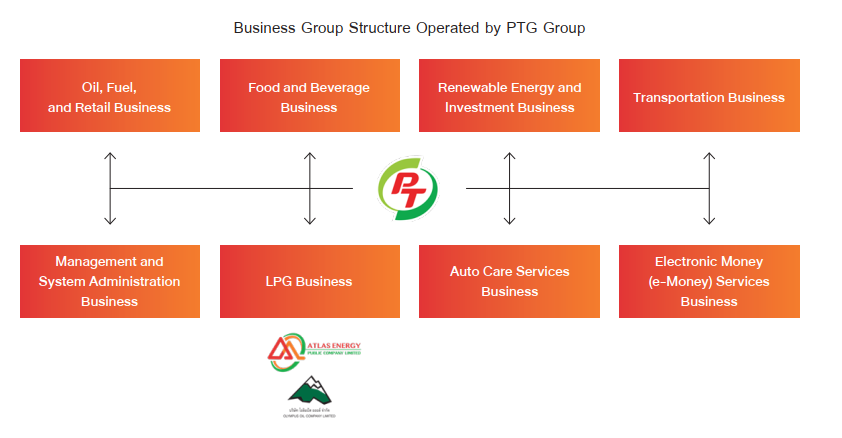
The Group purchases products and utilizes services from PTG Group for its business operations, while PTG Group also purchases products and uses services from the Group for its business activities. Key transactions between the Group and PTG Group include:
Management services for the oil retail operations at service stations.
Use of the "PT" trademark in the LPG distribution business.
Leasing of LPG Tank Trucks and vehicles for transporting bottled LPG.
Rental and sublease of gas service stations.
Participation in the Max Card loyalty program.
These intercompany transactions provide significant benefits to both the Group and the PTG Group. For example, the use of the “PT” trademark in the LPG distribution business allows the Group's products to be more widely recognized by consumers familiar with the established “PT” brand. On the other hand, PTG not only receives compensation for the use of its trademark by the Group but also benefits from enhanced brand recognition due to the variety of products associated with the “PT” trademark. This increased visibility could potentially enhance the future value of the “PT” brand. Moreover, the participation in the Max Card loyalty program enables the Group to run promotional campaigns that encourage repeat business from customers, without the need to create and manage a separate loyalty system. At the same time, the PTG Group benefits from the wide range of stores participating in the Max Card program, which helps foster higher customer satisfaction and loyalty. This broad network also increases the likelihood of attracting new members to the Max Card program. The Audit Committee and the Board of Directors have carefully reviewed the reasons for these transactions, their necessity, and their overall reasonableness. (Further details regarding intercompany transactions and the review process can be found in Section 2. Corporate Governance Item 9. on Internal Controls and Related Party Transactions.)
The Company held its Board of Directors’ Meeting No. 1/2024 on February 21, 2024, while PTG held its Board of Directors’ Meeting No. 1/2024 on February 22, 2024, to consider and approve the approach for clearly delineating the business operations between the Group and the PTG Group (which refers to PTG and its subsidiaries and associates, excluding the Company’s Group). This initiative aims to enhance the efficiency of joint business operations between the two parties. In 2025, the Company held its Board of Directors’ Meeting No. 1/2025 on February 4, 2025, while PTG held its Board of Directors’ Meeting No. 1/2025 on January 31, 2025, to consider and approve further clarification of the business separation approach. On July 23, 2024, the Group and the PTG Group executed a Memorandum of Business Cooperation. Subsequently, on February 5, 2025, the Group and the PTG Group executed a supplementary memorandum appended to the original Memorandum of Business Cooperation. The key content of these memoranda reflects the resolutions approved by the Boards of Directors of both the Company and PTG in 2024, with amendments as approved in 2025.
The approach for delineating business operations between the Group and the PTG Group can be summarized as follows:
The PTG Group is engaged in the sourcing and sale of petroleum fuel products for both retail and wholesale purposes, including but not limited to the retail sale of petroleum fuel products at fuel service stations (collectively referred to as the “Fuel Products Distribution Business”). For the purpose of this definition, “Fuel Products” refer to all types of petroleum fuels, including but not limited to gasoline and diesel, but excluding “liquefied petroleum products.”
In addition, the PTG Group also operates electric vehicle (EV) charging stations. The PTG Group may operate this business independently or in collaboration with other parties (collectively referred to as the "EV Charging Station Business").
On the other hand, the Group is involved in the sourcing and sale of liquefied petroleum gas (LPG) products for retail and wholesale, including but not limited to the retail of LPG at gas stations and the retail of bottled LPG at LPG distribution shops (collectively referred to as the "Liquefied Petroleum Gas Product Distribution Business"). "Liquefied Petroleum Gas Products" include all types of liquefied petroleum gas, such as Liquefied Petroleum Gas (LPG), Natural Gas for Vehicles (NGV), and Compressed Natural Gas (CNG).
The PTG Group has agreed not to engage in the sale of liquefied petroleum gas products, while the Group has agreed not to engage in the sale of fuel products or operate electric vehicle charging stations. Additionally, both the Group and PTG will exercise their shareholder rights in accordance with their ownership stakes in their respective subsidiaries and joint ventures, ensuring that their subsidiaries and joint ventures do not engage in businesses that directly compete with the operations of the other party, except for businesses with the following characteristics:
Sale of Liquefied Petroleum Gas (LPG) Products
The Company agrees to grant the PTG Group the right to sell LPG cylinders at PTG’s service stations for as long as PTG remains the authorized dealer of the Company's LPG products under the agreement for small Kiosks.
Sale of Fuel Products at OLP’s Gas Stations Offering Both LPG and Fuel (Gas Service Stations with oil retail operations)
The Company has agreed to grant the PTG Group the right to sell fuel within OLP’s service stations that include fuel retail sections, covering both existing stations and any future stations in which OLP invests. This is subject to the condition that the PTG Group must engage the Company’s Group to manage the sale of fuel within such gas stations that include fuel retail sections.
Leasing of Commercial area at Service Stations
The Company agrees to grant the PTG Group the right to lease commercial spaces within OLP’s gas stations for PTG’s business operations, which may include, but are not limited to, convenience stores, coffee shops, and electric vehicle (EV) charging stations.
PTG agrees to grant the Company the right to lease commercial areas within PTC’s oil stations for the Company’s business operations, which may include, but are not limited to, LPG cylinder Gas shops.
Leasing and Managing Service Stations Selling Liquefied Petroleum Gas Products
PTG agrees to allow the Company to lease and/or sublease gas stations that sell LPG products. These stations may include: 1) Service stations selling only LPG, 2) Service Stations selling both LPG and oil (Mixed Service Stations"), 3) Service stations selling both NGV and oil. These stations are either owned by PTG or leased from the property owners. PTG further agrees not to make any additional investments in such stations in the future.
The lease rates for these gas stations will be charged to the Company at a rate comparable to the terms PTG pays to the property owners. The lease and/or sublease will remain in effect until the expiration of the lease term PTG has with the property owners.
Upon the expiration of the lease and/or sublease term between PTG and the property owners, PTG agrees not to renew the lease and or the sublease. In such cases, the Company may enter into direct lease and/or sublease agreements with the property owners if the Company wishes to continue operating the gas stations.
In the future, if either the Company’s Group or the PTG Group intends to engage in a business that could be considered as competing with or expanding upon the business currently operated by the other party—provided that such business is not identical or the same in nature as the existing business of either party—the Company’s Group and the PTG Group agree to proceed as follows:
The party intending to invest in such business shall grant the other party the right to participate in the investment.
The party offered the opportunity to invest will arrange for management to conduct a feasibility study of the business, which will include an analysis of expected returns and the overall suitability of the investment. The results will then be presented to the audit committee and the board of directors for their consideration. The party offered the investment opportunity must notify their decision within a reasonable timeframe.
In the event that the party offered the investment opportunity chooses not to invest, the party wishing to invest in the business may proceed independently with the investment.
However, the investment must not cause the other party to breach any contractual obligations or violate agreements made with third parties.
As long as PTG remains the majority shareholder of the Company, holding more than 10% of the Company’s issued and paid-up capital, whether directly or indirectly, both the Company and the PTG Group agree to strictly adhere to the business separation guidelines outlined above.
Income Structure
Introduction
The Group engages in the business of distributing LPG, with a focus on providing comprehensive distribution and meeting the demand for LPG consumption of gas consumers across all key sectors, namely the automotive sector, the household sector, and the industrial sector. In this regard, the revenue structure of the Company and its subsidiaries from 2021 to 2024, based on the pro forma consolidated financial statements , and in 2025 based on the reviewed financial statements, when classified by the nature of sales and services, can be summarized as follows:
Product / Service Income
| Category | Description | This Year | This Year % | Last Year | Last Year % | 2 Years Ago | 2 Years Ago % |
|---|---|---|---|---|---|---|---|
| Total revenue from operations | Total revenue from operations | 11,966,758.54 | 100 | 11,023,711.18 | 100 | 9,576,851.82 | 100 |
| Revenue from the LPG Sales from the Household Sector /2 | 2,271,133.82 | 18.98 | 2,045,649.82 | 18.56 | 1,761,481.14 | 18.39 | |
| Revenue from the LPG Sales from the Automotive Sector | 7,291,118.3 | 60.93 | 6,833,789.84 | 61.99 | 5,946,238.12 | 62.09 | |
| Revenue from the LPG Sales from the Industrial Sector | 797,717.22 | 6.67 | 715,343.98 | 6.49 | 658,024.56 | 6.87 | |
| Revenue from Oil Management Services /3 | 1,118,575.82 | 9.35 | 977,893.37 | 8.87 | 842,232.52 | 8.79 | |
| Revenue From the Sale of Other Products /4 | 137,875.89 | 1.15 | 115,692.61 | 1.05 | 74,824.83 | 0.78 | |
| Revenue from the Sale of Goods and Services - Advertising /5 | 172,991.25 | 1.45 | 166,795.56 | 1.51 | 173,665.54 | 1.81 | |
| Revenue from the Sale of Goods and Services - Rent and Other Service Fees /6 | 141,705.3 | 1.18 | 120,892.68 | 1.1 | 99,274.3 | 1.04 | |
| Other | Others | 35,640.94 | 0.3 | 47,653.32 | 0.43 | 21,110.81 | 0.22 |
Export Income
| Category | Description | This Year | This Year % | Last Year | Last Year % | 2 Years Ago | 2 Years Ago % |
|---|---|---|---|---|---|---|---|
| Total revenue | Total revenue | 11,966,758.54 | 100 | 11,023,711.18 | 100 | 9,576,851.82 | 100 |
| Domestic | Domestic | 11,966,758.54 | 100 | 11,023,711.18 | 100 | 9,576,851.82 | 100 |
| International | International | 0 | 0 | 0 | 0 | 0 | 0 |
Other Income
| Operating Other Income | Non-Operating Other Income | Share of Profit |
|---|---|---|
| 1710 · As of year: 0.0 · Description: Total other income · As of yesteryear: 0.0 · As of year before yesteryear: 0.0 · 1711 · As of year: 0.0 · Description: Other income from operations · As of yesteryear: 0.0 · As of year before yesteryear: 0.0 | 1712 · As of year: 0.0 · Description: Other income not from operations · As of yesteryear: 0.0 · As of year before yesteryear: 0.0 | 1713 · As of year: 0.0 · Description: Share of profit · As of yesteryear: 0.0 · As of year before yesteryear: 0.0 |
Product / Service Characteristics
Business Type
3114
Business Groups
| Business Group | Description |
|---|---|
| LPG distribution for household sector | As part of its household sector operations, the Company sells liquefied petroleum gas (“LPG” or “cooking gas”) to household users. These customers typically purchase LPG in relatively small quantities per transaction or lack on-site LPG storage facilities. As a result, LPG sold to household users is primarily supplied in the form of LPG filled into small portable cylinders (“LPG cylinders”), available in various sizes to suit different usage patterns and customer needs. The Company distributes LPG cylinders under the “PT” trademark, as it believes that the PT brand has long been well recognized by consumers. Leveraging this established brand enhances the Company’s market accessibility and consumer acceptance. At present, LPG cylinders sold to household users can be categorized by usage characteristics and customer groups as follows: (1) Small-sized LPG cylinders, including 4 kg, 7 kg, and 12.5 kg cylinders, which are suitable for consumers with relatively low LPG consumption and who do not require large-volume storage. (2) Standard-sized LPG cylinders, comprising 15 kg cylinders commonly used by households and small businesses with moderate LPG consumption, and 48 kg cylinders, which are generally used by businesses with higher LPG demand. (3) Specialized LPG products, such as LPG cylinders for forklift trucks that use LPG as fuel, as well as the 12.5 kg “PT ALUMax” LPG cylinder. PT ALUMax cylinders are manufactured from aluminum, which prevents corrosion during use. These cylinders are produced using a seamless molding process and therefore have no welded joints, unlike steel cylinders that require welding during assembly and may be vulnerable to corrosion at welded seams. As a result, aluminum cylinders offer enhanced safety compared with conventional steel cylinders. In the past, the Company has established a requirement to prepare reports on the evaluation of the Company’s gas cylinders every 6 months to control and monitor the Company’s gas cylinders. The Company uses statistical data of cooking gas filling to calculate the turnover rate of cooking gas cylinders and then uses this rate to determine the number of cooking gas cylinders circulating in the business operations. After that, the Company compares the calculated number of cooking gas cylinders with the number of gas cylinders recorded in the Company’s system. If the calculated number is lower than the number recorded in the system, the Company will hire an independent appraiser to evaluate the Company’s gas cylinders. If the appraisal value by the independent appraiser is lower than the carrying amount recorded in the financial statements, the Company will recognize an impairment loss on the asset in the financial statements. The Company’s household LPG sales volume amounted to 76,611.5 tons in 2023, 86,929.9 tons in 2024, and 94,712.4 tons in 2025. As household LPG is distributed primarily in cylinder form, LPG Filling plants constitute a critical component of the Company’s household LPG distribution operations. LPG cylinders sold to customers are filled using LPG Filling plants operated and managed by the Company (“Company-operated LPG Filling plants”). Historically, the Company has focused on investing in and operating its own LPG Filling plants, as direct ownership and management allow the Company to maintain operational oversight and quality control while supporting strategic geographic expansion. The Company invests in LPG Filling plants through 2 principal approaches:
As of December, 2025, the Company operates 9 LPG Filling plants with a combined maximum filling capacity of approximately 11,750 tons per month. These plants support the filling and distribution of LPG cylinders in Bangkok and its vicinity, the Eastern region, and select parts of the Southern region. In addition, the Company plans to expand its filling operations to the Northern and Northeastern regions, which also have high demand for LPG. (Further details regarding the Company’s investment in gas filling plants in the future are presented in Section 1. Business Operations and Operating Results, under the Objectives of the Use of Proceeds, under Item 1 Investment in assets used by the Company for its business operations, Sub-item 1.1) Investment to increase LPG filling stations and LPG retail outlets to support the growth of the household LPG distribution business.) The Company focuses on investing in LPG Filling plants located in strategically important areas to ensure that its LPG filling plant network covers regions with high and consistent demand for LPG cylinders. In addition, the Company emphasizes investment in LPG Filling plants with high maximum filling capacity (Max Capacity) that can support long-term operations. This approach is adopted because upgrading LPG Filling plants to increase their maximum filling capacity at a later stage can be operationally complex and costly. Such upgrades may also affect the filling and distribution of LPG cylinders to nearby areas during the renovation period. However, investing in LPG Filling plants with high maximum capacity may result in LPG cylinder sales volumes during the initial phase being lower than the plant’s available production capacity. As a result, the Company requires time to establish a customer base and gradually increase sales volumes in order to achieve its targeted levels. Consequently, the utilization rate of such LPG Filling plants may not be high during the initial stage of operations. Nevertheless, the Company has established guidelines to increase LPG cylinder sales in the areas where its LPG Filling plants are located. The Company assigns sales personnel stationed at each LPG filling plant to survey and identify local operators who require LPG cylinders in large quantities and are likely to use them on a continuous basis. These sales personnel are responsible for developing plans to meet with such operators in order to introduce and offer the Company’s products. In addition, the Company continuously focuses on increasing the number of the COCO Gas shops in areas surrounding its LPG Filling plants in order to further expand LPG cylinder distribution channels. This strategy also enhances the Company’s ability to distribute and deliver LPG cylinders more extensively across various areas. (Further details regarding risks associated with some of COCO Filling plants having relatively low utilization rates, please refer to Section 1. Business Operations and Performance, Item 2 Risk Management, under 2.2.1 Risks Related to the Company’s Business and Operations, Sub-item 6) Risk from the relatively low Utilization Rate of newly opened gas filling plants) In the distribution of liquefied petroleum gas (LPG) in cylinders to household users, the Company supplies LPG filled at its own Filling plants, as well as LPG cylinders filled at dealer’s Filling plants ("DODO Filling plants"). Previously, the Company appointed operators of LPG Filling plants as authorized dealers ("LPG Filling plants’ Dealer") and issued letters of appointment for them to trade in liquefied petroleum gas ("LPG Trading Licenses"). This arrangement allows dealer’s Filling plants to fill LPG into the Company's cylinders and sell them directly to household users or to Gas shops that will then distribute them to end-users. The Company requires that all LPG Filling plants appointed as the Company’s sales agents must fill cooking gas exclusively into the Company’s own LPG cylinders. In 2025, the Company has a total of 30 Filling plants operated by its authorized dealers. |
| LPG distribution for automotive sector | The Company supplies LPG to users in the automotive sector through its LPG service stations, operating under the "PT" trademark. This approach is based on the belief that most vehicle owners are already familiar with the "PT" brand, which has established a strong presence over the years. Using the "PT" trademark for LPG service stations helps the Company’s stations gain rapid recognition and trust among vehicle users. Additionally, the Company has introduced the "LPG+" mark alongside the "PT" trademark to clearly differentiate its LPG service stations, making it easier for customers to identify stations that provide LPG services. The LPG service stations operated by the Company for vehicle users are categorized based on the types of petroleum products offered, as follows: (1) LPG Stand alone Service Stations: These stations are typically located on smaller plots of land. Due to legal requirements regarding the necessary distance between buildings and other structures, stations on smaller plots are unable to construct large facilities. Consequently, these stations have fewer dispensers and fueling points, making them unsuitable for offering a wide range of petroleum products, particularly various types of fuel oils. (2) Service Stations Offering Both LPG and Oil (“LPG Service stations with Oil Retail Operations”): These stations are usually situated on larger plots of land, allowing for the construction of bigger buildings or multiple structures. These stations have distinct areas for LPG sales (“LPG Retail Operations”) and fuel oil sales (“Oil Retail Operations”), enabling them to provide both LPG and fuel to vehicle users. The Company has continuously expanded the number of LPG stations that also sell fuel ("LPG Service stations with Oil retail operations"). This is because vehicles that use LPG as fuel still require oil fuel for the engine to start during initial operation. Customers using LPG as fuel, the Company's target market, still need to refuel with both LPG and oil. Therefore, the Company believes that stations offering both LPG and oil better meet the needs of LPG vehicle users compared to those offering only LPG. Regarding LPG sales in the automotive sector, the Company sold 237,423.3 tons in 2023, 273,036.5 tons in 2024 and 291,367.1 tons in 2025. |
| LPG distribution for industrial sector | In the industrial sector, the Company supplies LPG to businesses that require large volumes of LPG for their operations. The LPG is delivered in its “LPG liquid form,” transported by LPG trucks. Upon arrival at the customer's facility, the LPG is transferred from the truck into the customer’s bulk storage tanks (Bulk Tanks). The Company distributes LPG to industrial users in the form of business-to-business transactions (Business to Business: B2B). Accordingly, the Company does not use the “PT” trademark in conducting its LPG distribution business in the industrial sector. The Company’s LPG sales in the industrial sector amounted to 28,980.3 tons in 2023, 31,462.1 tons in 2024 and 35,084.5 tons in 2025. |
| Oil management service at service stations | In the past, the Company has operated LPG service stations serving motorists who use LPG as fuel in two formats: (1) service stations that sell LPG only, and (2) service stations that sell both LPG and petroleum products (“LPG service stations with integrated fuel retail facilities”). The Company has established LPG service stations with integrated fuel retail facilities because it recognizes that such stations can better meet the needs of motorists who use LPG as fuel, which constitute the Company’s target customer group, compared with stations that sell LPG only. This is because vehicles using LPG as fuel still require gasoline during the initial engine start-up phase each time the vehicle is operated. Therefore, when motorists who use LPG as fuel visit service stations that also offer petroleum products, they are able to refuel both LPG and gasoline at the same service station. However, in order to ensure clarity in business operations between the Company and OLP (the “Group of Companies”) and PTG and its subsidiaries and associates (the “PTG Group”), particularly with respect to the fuel retail business within PT service stations, the Board of Directors’ Meeting No. 1/2567 approved the granting of rights to the PTG Group to sell petroleum products within LPG service stations operated by OLP that also include fuel retail facilities, subject to the condition that the PTG Group appoints the Group of Companies to manage the oil retail operations at such service stations. Accordingly, on 5 June 2024, OLP and Petroleum Thai Corporation Co., Ltd. (PTC) entered into a Business Operation Rights and Management Agreement for service stations. Under the agreement, OLP granted PTC the right to operate the fuel retail business within LPG service stations that also include fuel retail facilities (the “Authorized Service Stations”). At the same time, PTC appointed OLP to manage the oil retail operations at the Authorized Service Stations. OLP and PTC have agreed on the scope of responsibilities for each party. PTC is responsible for procuring and ordering the petroleum products sold at the fuel retail sections of the Authorized Service Stations, as well as arranging and planning the transportation of petroleum products to the service stations and monitoring the quality of the petroleum products sold. Meanwhile, OLP is responsible for managing the fuel retail operations to ensure that daily fuel sales are carried out in accordance with agreed arrangements. Such responsibilities include inspecting operational readiness of the fuel retail section, managing manpower for fuel retail operations to ensure operational efficiency, providing refueling services to motorists, as well as summarizing daily sales and remitting proceeds from fuel sales to PTC. As of the end of 2025, the Company operated 181 LPG service stations with integrated oil retail operations (including 1 service station offering both NGV and oil). OLP has granted PTC the right to sell oils at such service stations. As a result, OLP has not recognized revenue from petroleum sales at these service stations since June 2024 onward. Nevertheless, OLP receives compensation from granting such rights and from managing the fuel retail operations at the service stations, which is charged to PTC. According to the consolidated financial statements, OLP recognized management service income from fuel retail operations amounting to 569.0 million baht in 2024 and 1,118.6 million baht in 2025. With respect to the consideration for granting the right to sell oils and for providing management services for the oil retail operations at service stations (“oil Management Fee”), the Company and PTG have mutually agreed that such management fees will vary in accordance with the actual volume of oil products sold. Accordingly, the management fee is determined on a Baht-per-liter basis. The management fee is calculated using a cost-plus pricing approach (Cost Plus Pricing), whereby:
The Company and PTG have agreed that the management fee rate will be reviewed every three months. To facilitate such review, the Company and PTG have established a Joint Committee for Service Station Management (“Joint Committee”), consisting of five members, including two representatives from the Company, two representatives from PTG, and one Chairperson, who is a representative from PTG. The Chairperson has a casting vote in the event of a tie. The Joint Committee is responsible for monitoring the implementation of the fuel retail management arrangement and reviewing the terms and conditions of such arrangement to ensure that they remain appropriate and fair to both parties. This includes reviewing expenses related to petroleum sales incurred during the preceding quarter, as well as the allocation of shared expenses arising from multiple operational functions, so that only expenses related to petroleum sales are included. Such allocation is conducted using the Allocation Factors, for which the Company is required to prepare the relevant information to support the Joint Committee’s assessment of the appropriateness of the Allocation Factors. Following each meeting of the Joint Committee, the representatives of each party will submit the results of the quarterly meeting to the Audit Committee and the Board of Directors of both the Company and PTG for consideration and approval of the management fee rate for the respective quarter. However, in the event that the Joint Committee is unable to reach a conclusion, the representatives of each party will submit the results of the meeting to the Audit Committee and the Board of Directors of both the Company and PTG for further consideration, after which the matter will be brought back to the Joint Committee for further deliberation. In addition, on a quarterly basis, the Audit Committee considers the rationale and necessity of entering into such transactions, as well as the reasonableness of related-party transactions between the Group of Companies and the PTG Group. The transaction relating to the granting of rights and the management of fuel retail sections within LPG service stations is reviewed as a separate agenda item from other related-party transactions. Any changes to the terms and conditions of the fuel retail management arrangement, including the management fee rate, will become effective only when OLP and PTC have mutually agreed to such changes in writing. |
| Advertising service | The outbreak of the coronavirus disease (“COVID-19”) in Thailand since 2020 significantly affected daily life and livelihoods across the country, including professional drivers, particularly taxi drivers, who were severely impacted by reduced travel caused by economic conditions and public concerns about using public transportation. In response, the Company implemented several initiatives to support taxi drivers. One of the key initiatives was the campaign “We Will Get Through This Together #TaxiFightsCOVID”, which aimed to promote public awareness and preventive measures against COVID-19 through participating taxis. Taxi drivers who joined the campaign installed public awareness materials and advertising media both inside and outside their vehicles. In return, participating drivers received LPG discount coupons for use at the Company’s gas stations, as well as cash-equivalent e-vouchers redeemable for products and services offered by the Group and the PTG Group. The campaign received strong participation from taxi drivers using LPG as fuel, with many continuing their involvement over time. The initiative also enhanced awareness and acceptance of the Company’s gas stations among taxi drivers. In addition, the Company previously utilized taxi-based advertising to promote the “PT Taxi Transform” project and found that a significant number of taxi drivers became aware of the project through advertisements displayed on taxis. Based on these experiences, the Company recognized that taxi advertising offers high visibility (“Eye Ball”), as taxis operate on public roads for extended periods and travel across diverse locations. Consequently, taxi advertising has become a highly demanded advertising channel. The Company therefore developed this initiative into a commercial advertising business under the brand “Max Taxi Ads.” Once a customer agrees to use the Company’s advertising services, the Company coordinates with the customer to produce advertising materials in the form of stickers to be installed on designated areas of taxis. The Company then contacts taxi drivers who wish to participate in the program and schedules installation at the Company’s service stations. The Company charges advertising fees in two components: (1) “Installation service fee”, charged monthly based on the agreed installation rate and the number of taxis on which advertising materials are installed during that month (charged only for the first installation per taxi); and (2) “Monthly advertising fee”, charged based on the agreed advertising rate and the cumulative number of taxis displaying advertisements as of the end of each month, payable throughout the agreed service period. Participating taxi drivers receive compensation in the form of discount coupons and cash-equivalent e-vouchers credited to their Max Card membership accounts once the advertising materials are installed. Drivers may continue to use these benefits provided that the advertising stickers remain installed. In the event of damage to the stickers, drivers must notify the Company and arrange for replacement installation before continuing to use the coupons and E-vouchers. In 2025, the Company deployed approximately 20,000 advertising units on taxis. PTG was a major customer, accounting for a significant portion of taxi advertising usage, as PTG’s target customers are motorists, which aligns well with the target audience of taxi-based advertising. Nevertheless, the Company continues to designate responsible personnel to coordinate with and provide support to customers (Account Executive: AE) to actively seek and propose services to additional customers in order to expand the customer base and grow the taxi advertising business. As a result, taxi advertising represents a new business line that extends from the Company’s core LPG transportation fuel business, creating additional value through the effective utilization of the Company’s assets, including its strong relationships with taxi drivers. In addition to providing advertising media services on taxis, the Company has recognized opportunities to further utilize its assets to expand advertising services in other formats. Accordingly, the Company has assigned Account Executives (AE) to identify potential customers and offer advertising media services within the Company’s LPG service stations. In 2025, the Company entered into agreements to provide advertising media services within its LPG service stations to six customers (who are not part of the PTG Group). Under such agreements, customers are permitted to install advertising media in the form of advertising posters at various locations within the service stations as agreed with the Company. The Company charges advertising fees in the form of a monthly advertising service fee, which is calculated based on the advertising service rate agreed with the customer and the number of service stations where the customer wishes to display advertising media. The Company will continue to charge such monthly advertising service fees until the agreed service period with the customer has expired. Furthermore, the Company plans to expand advertising media services within its service stations to better meet customer demand. For example, the Company intends to introduce digital advertising media in the form of motion graphics displayed on screens installed within service stations. |
Research & Development
Has R&D Policy (Y/N)
No
R&D Cost — Label
Research and development (R&D) expenses over the past 3 years (Million Baht)
Assets Used in the Business
Introduction
As of December 31, 2025, the Company’s significant assets used in its business operations include:
Investments in Subsidiaries
The Company currently holds an investment in one subsidiary, Olympus Oil Co., Ltd. (OLP), which operates in the LPG Automotive sector. OLP manages the Company's LPG service stations. As of December 31, 2025, the net book value of the investment in OLP is 107.3 million baht.
Company Name | Paid-up Capital (Million Baht) | Shareholding Proportion (%) | Book Value at Cost Method (Million Baht) |
|---|---|---|---|
Olympus Oil Company Limited | 100.0 | 100.0 | 107.3 |
Total | 107.3 | ||
2. Investment Properties
As of December 31, 2025, the Company holds investment properties valued at 267.2 million baht. These properties consist of buildings and other structures located in the commercial areas within the Company's gas stations. The Company leases these spaces to operators who wish to sell products and services at the gas stations. The Company has established a policy to conduct a valuation of its investment properties every 3 years.
Permanent Assets — Description
As of December 31, 2025, the Company’s fixed assets used in its operations are valued at 2,726.3 million baht, with the following details:
Permanent Assets — Appraisal
| Asset | Ownership | Obligation | Appraisal Value | Description |
|---|---|---|---|---|
| Land and Land Improvements | Owned | None | 131.3 | Land and Land Improvements include the land acquired by the Company for the construction of two LPG Filling plants and three gas stations. |
| Buildings and Building Improvements | Owned | None | 1,046.6 | Buildings and Building Improvements include 1) The buildings and structures within the Company’s LPG Filling plants, and 2) The buildings and structures within the Company’s gas stations. |
| Machinery and Equipment | Owned | None | 709.1 | Significant Tools and Equipment include 1) Large LPG storage tanks ("LPG reserve tanks") at the Company’s two gas depots; 2) Underground LPG storage tanks ("underground gas reserve tanks") at the Company’s gas stations; and 3) Conveyor-based LPG filling systems ("conveyor filling systems") at the Company’s Filling plants. |
| LPG Cylinders | Owned | None | 730.4 | |
| Furniture, Fixtures, and Office Equipment | Owned | None | 37.3 | Significant Fixtures, Installations, and Office Equipment include tools and office equipment used at the Company’s gas depots, gas stations, gas Filling plants, Gas shops, as well as at the Company’s headquarters.
|
| Vehicles | Owned | None | 27.7 | Significant Vehicles include pickup trucks and motorcycles equipped for transporting LPG cylinders at the COCO Gas shops, and motorcycles used at the COCO Service stations.
|
| Construction in Progress | Owned | None | 43.9 | Significant Work in Progress includes ongoing improvement and installation work at the Company’s gas stations, gas Filling plants, and Gas shops. |
Intangible Assets — Description
As of December 31, 2025, the Company holds intangible assets totaling 12.4 million baht. The primary intangible assets include software and applications developed for the LPG distribution business, as well as operating system software for office use.
Has Subsidiaries Investment Policy (Y/N)
No
Marketing Policy & Competition
Reporting Mode
3117
Marketing Policy (Overall)
LPG Distribution Business for the Household Sector
The Company places strong emphasis on building customer confidence in its products, particularly with respect to the safety of its LPG Cylinders. Accordingly, the Company requires that all of its LPG cylinders, except for 4-kilogram cylinders which contain relatively small volumes of LPG, be equipped with a check lock valve. This valve mechanism prevents LPG from escaping from the cylinder if it is not properly connected to a gas regulator or an LPG pigtail hose. As a result, cylinders equipped with check lock valves can effectively prevent gas leakage in cases where the cylinder valve is accidentally opened. The Company also places importance on the inspection of LPG cylinders that are returned for refilling. Personnel at the Filling plants are required to inspect each cylinder both before and after refilling. If any cylinder is found to be unsuitable for use, such as having dents in the cylinder body or gas leakage from the cylinder or valve, it will be segregated, collected, and sent for repair.
The Company also focuses on building long-term relationships with customers through sales promotion and marketing activities that are aligned with customer needs. The Company has participated as a merchant in the loyalty membership program of PTG known as the Max Card program (“Max Card Loyalty Program”), for which the PTG Group acts as the administrator of the program (“Card Program Administrator”). Participation in the Max Card Loyalty Program enables the Company to leverage the system to provide benefits to the Company’s customers who are members of the Max Card Loyalty Program (“Max Card Members”) when purchasing products or using services provided by the Company, such as:
The accumulation of reward points from purchases of the Group’s products in accordance with conditions specified by the Company (for example, points earned based on the volume of LPG refueled at LPG service stations). The Company is required to pay the Card Program Administrator for such accumulated points based on the total number of points earned by customers from product purchases in each month. Allowing customers to accumulate points from purchases of the Company’s products encourages customers to make continued purchases in order to earn additional points. Accordingly, the points accumulation program forms part of the Company’s customer relationship management (CRM) strategy.
Redemption of accumulated points for discounts on purchases of the Group’s products. Customers pay the Company the net amount after applying such discounts and benefits, while the Company subsequently claims reimbursement for the redeemed points from the Card Administrator. Enabling point redemption encourages customers to increase purchases in order to utilize their accumulated benefits and is also part of the Company’s customer relationship management (CRM) strategy.
The use of discounts or other benefits as determined by the Company (for example, discounts offered for LPG purchases by taxi drivers participating in the “Taxi Ads” program). Customers who utilize such discounts or benefits will pay the Company the net purchase amount after deduction of the applicable discounts or benefits, with the Company being responsible for such discounts or benefits. The provision of additional discounts or benefits is considered part of the Company’s customer relationship management (CRM) strategy.
In addition to customer retention efforts, the Company places importance on enhancing brand awareness for its LPG Cylinders. The marketing team regularly organizes promotional activities targeted at key customer groups, such as food vendors and restaurant operators in various markets. Marketing personnel, together with staff from Gas shops, conduct on-site visits to target customers to provide product information, promotional offers, and details on how to place orders through the Company’s nearby LPG Gas shops. These activities support both customer acquisition and ongoing engagement with existing customers.
LPG Distribution Business for the Transportation Sector
The Company places strong emphasis on building long-term relationships with customers. The Company believes that high-quality service and positive customer experiences are key factors that encourage customers to continue purchasing products and using the Company’s services over the long term. Accordingly, the Company primarily focuses on investing in and operating its LPG service stations directly. This approach enables the Company to enhance the image of its service stations to reflect a modern and well-maintained appearance. Such improvements include renovating and refurbishing building structures within the service stations to maintain them in good condition, upgrading equipment and systems within the stations—including LPG dispensers—to ensure that customers receive accurate quantities of LPG, and improving lighting systems within the service stations to enhance customer safety and confidence when using the facilities. In addition, the Company also renovates restroom facilities to ensure that they are suitable for customer use.
The Company also focuses on building long-term relationships with customers through sales promotion and marketing activities that are aligned with customer needs. The Company has participated as a merchant in PTG’s loyalty membership program known as the Max Card program (“Max Card Loyalty Program”). Participation in this program enables the Company’s customers who are members of the Max Card Loyalty Program (“Max Card Members”) to receive various benefits from purchasing products and using services provided by the Company, such as accumulating reward points that can be redeemed for discounts.
Furthermore, the Company builds customer relationships through various initiatives. During the COVID-19 pandemic, which significantly affected livelihoods and occupations, particularly taxi drivers who were severely impacted by reduced public transportation usage, the Company participated in the “PT Pantry of Sharing” project by installing donation cabinets at its gas service stations to support those affected by the pandemic. The Company also joined the COVID-19 disinfection spraying project, providing virus disinfection services for taxis and private vehicles at its gas service stations. In addition, the Company implemented the “We Will Get Through This Together #TaxiFightsCOVID” campaign, offering LPG and fuel discounts to taxi drivers who participated in public awareness campaigns by displaying COVID-19 prevention messages on their vehicles.
Beyond crisis support initiatives, the Company has implemented programs to promote increased LPG usage among vehicle operators. The Company launched the “PT Taxi Transform Change for the Future” project, encouraging taxi drivers, hired vehicles, and other public transportation vehicles using NGV or gasoline to convert their vehicles to LPG. Participants pay an application fee as part of the equipment installation cost, while the Company subsidizes the remaining cost. Participants receive LPG and fuel discounts through their Max Card membership and are required to purchase LPG from the Company at or above a minimum monthly volume for a specified period.Participants in these programs receive discounts on LPG and fuel purchases through their respective Max Card membership cards. The Company requires all participants in the “Taxi Transform” and “Auto Transform” programs to be Max Card Members in order to receive such discounts. This requirement enables the Company to appropriately monitor LPG refueling behavior of program participants. The Company monitors the LPG refueling activities of program participants on an ongoing basis. If a participant refuels LPG at a volume lower than the prescribed minimum level, the Company will contact such participant to inquire about potential issues related to LPG usage and encourage the participant to refuel LPG with the Company in accordance with the specified conditions. In addition, the Company has established an impairment policy for costs directly related to contracts, representing the net value of equipment invested by the Company for program participants. The Company assesses the Value in Use (VIU) of such assets by considering factors including the average monthly LPG consumption per participant, the remaining useful life of the equipment, and the gross profit margin after deducting related expenses. If the carrying amount of the incremental costs of obtaining contracts with customers (i.e., the net value of equipment invested by the Company for program participants) exceeds the value in use, the Company will recognize an impairment loss on such assets on a quarterly basis.
In addition to customer engagement, the Company places importance on building positive relationships with local communities. The Company provides employment opportunities at its service stations to residents living in nearby communities. The Company believes that local employees better understand the needs of customers in the same area, can provide appropriate services, and benefit from proximity to their families. This approach also supports community acceptance and strengthens relationships between the Company’s gas service stations and surrounding communities.
LPG Distribution Business for the Industrial Sector
The Company prioritizes ensuring that LPG deliveries to industrial customers meet the agreed-upon terms, including the required volume and timeliness to fulfill customers' operational needs. To achieve this, the Company places significant emphasis on the entire supply chain process, from LPG procurement to delivery planning. The Company sources LPG from multiple large suppliers and works closely with them to plan orders and deliveries in advance, enabling suppliers to align their production schedules with the Company’s requirements. The Company partners with a range of reliable transport service providers that operate large fleets of LPG tankers (with a great number of LPG tankers), ensuring that LPG deliveries to customers are made on time.
In addition, for customers who need to invest in the installation or repair of gas delivery systems within their premises, the Company may support such investments for the customers if, upon reviewing the results of the feasibility study, the Company finds that the expected returns meet the criteria set by the Company. However, customers who wish to receive investment support from the Company must enter into an LPG purchase agreement with the Company under the terms and duration specified by the Company.
Industry & Competition (Overall)
1. Industry Competition, Competitors, and Market Share
The LPG distribution business is considered to have relatively high entry barriers due to the need for compliance with various relevant laws, including the Petroleum Act, B.E. 2543 (A.D. 1999) and its amendments. This means that operators wishing to become traders under Section 7 ("Traders under Section 7") must apply for a license in accordance with the criteria and procedures specified by the law. To be granted such a license, operators must meet specific legally required qualifications, including having a registered capital and paid-up capital of at least 50 million baht, working capital of at least 100 million baht, and ownership or leasing rights to an LPG storage facility. Once licensed as a trader under Section 7, the operator is required to adhere to certain legal obligations, such as maintaining mandatory reserves and preparing and reporting accounts for the import, purchase, refining, production, acquisition, sale, and remaining inventory of each type of fuel sold. Furthermore, becoming a trader under Section 7 involves significant financial investment in both business assets and working capital. As of 2025, there are a total of 12 traders under Section 7 operating in the LPG distribution sector ("LPG Traders"), listed below:
(1) Atlas Energy Public Company Limited (“the Company”)
(2) PTT Public Company Limited
(3) PTT Oil and Retail Business Public Company Limited
(4) Siamgas and Petrochemicals Public Company Limited
(5) Unique Gas and Petrochemicals Public Company Limited
(6) WP Energy Public Company Limited
(7) PAP Gas One Company Limited
(8) Orchid Gas (Thailand) Company Limited
(9) Uno Gas Company Limited
(10) NS Gas LPG Company Limited
(11) Bangchak Corporation Public Company Limited
(12) IRPC Public Company Limited
The Proportion and Volume of LPG Sales by LPG Traders in Thailand from 2021 to 2025
2021 | 2022 | 2023 | 2024 | 2025 | ||||||
|---|---|---|---|---|---|---|---|---|---|---|
Quantity 1/ (Million Kg) | Proportion (Percent) | Quantity 1/ (Million Kg) | Proportion (Percent) | Quantity 1/ (Million Kg) | Proportion (Percent) | Quantity 1/ (Million Kg) | Proportion (Percent) | Quantity 1/ (Million Kg) | Proportion (Percent) | |
1.PTT Oil and Retail Business | 1,436.1 | 42.6 | 1,489.2 | 41.1 | 1,460.3 | 40.1 | 1,451.4 | 39.2 | 1,472.9 | 39.5 |
2. Siamgas2/ | 758.7 | 22.5 | 799.2 | 22.1 | 810.0 | 22.2 | 822.8 | 22.2 | 841.7 | 22.5 |
3. WP | 594.8 | 17.6 | 690.9 | 19.1 | 719.3 | 19.8 | 758.5 | 20.5 | 742.2 | 19.9 |
4. The Company | 163.9 | 4.9 | 266.0 | 7.3 | 337.6 | 9.3 | 382.9 | 10.4 | 414.6 | 11.1 |
5. PAP Gas | 129.2 | 3.8 | 118.8 | 3.3 | 110.1 | 3.0 | 102.5 | 2.8 | 95.1 | 2.6 |
6. Orchid Gas | 114.6 | 3.4 | 118.3 | 3.3 | 101.6 | 2.8 | 94.8 | 2.6 | 82.1 | 2.2 |
7. Uno Gas | 30.0 | 0.9 | 33.5 | 0.9 | 29.7 | 0.8 | 20.9 | 0.6 | 27.1 | 0.7 |
8. NS Gas | 12.4 | 0.4 | 16.3 | 0.5 | 24.1 | 0.7 | 27.9 | 0.8 | 25.3 | 0.7 |
9. Bangchak | 8.6 | 0.3 | 15.2 | 0.4 | 17.6 | 0.5 | 22.8 | 0.6 | 23.4 | 0.6 |
10. Big Gas | 20.2 | 0.6 | 16.2 | 0.4 | 16.4 | 0.4 | 3.9 | 0.1 | 4.1 | 0.1 |
11. IRPC | 4.1 | 0.1 | 3.4 | 0.1 | 3.7 | 0.1 | 4.1 | 0.1 | 4.1 | 0.1 |
12. PTT | 3.8 | 0.1 | 3.6 | 0.1 | 3.7 | 0.1 | 5.8 | 0.2 | - | - |
13. Takuni | 25.9 | 0.8 | 28.6 | 0.8 | 7.2 | 0.2 | - | - | - | - |
14. Esso | 22.9 | 0.7 | 21.6 | 0.6 | - | - | - | - | - | - |
15. Thai Gas | 41.1 | 1.2 | - | - | - | - | - | - | - | - |
16. Sangthong | 6.0 | 0.2 | - | - | - | - | - | - | - | - |
Total | 3,372.2 | 100.0 | 3,620.8 | 100.0 | 3,641.3 | 100.0 | 3,698.4 | 100.0 | 3,732.6 | 100.0 |
Source: Department of Energy Business, Ministry of Energy
Notes: 1/ The LPG sales volume indicated above refers to the amount sold by traders under Section 7 to different consumer groups, including households, the automotive sector, and the industrial sector. It also includes the volume sold to traders under Section 10 for further distribution to these consumer groups. However, the volume does not include LPG used as raw material in the petrochemical industry.
2/ The sales volume for Siamgas includes the sales volume from Unique Gas & Petrochemical Public Company Limited and and Siamgas and Petrochemicals Public Company Limited.
The Company supplies LPG to various consumer groups, including households, the automotive sector, and the industrial sector. The distribution volume and market share for LPG sales in each of these sectors by the gas traders are as follows:
Market Share and LPG Distribution Volume by Traders under Section 7 in the Household Sector from 2021 to 2025
2021 | 2022 | 2023 | 2024 | 2025 | ||||||
|---|---|---|---|---|---|---|---|---|---|---|
Quantity 1/ (Million Kg) | Proportion (Percent) | Quantity 1/ (Million Kg) | Proportion (Percent) | Quantity 1/ (Million Kg) | Proportion (Percent) | Quantity 1/ (Million Kg) | Proportion (Percent) | Quantity 1/ (Million Kg) | Proportion (Percent) | |
PTT Oil and Retail Business | 981.6 | 47.9 | 987.6 | 47.7 | 982.0 | 47.7 | 989.0 | 47.4 | 1,011.2 | 47.5 |
Siamgas2/ | 488.9 | 23.9 | 487.6 | 23.6 | 467.0 | 22.7 | 474.3 | 22.7 | 481.7 | 22.6 |
WP | 417.5 | 20.4 | 430.1 | 20.8 | 446.8 | 21.7 | 460.6 | 22.1 | 461.2 | 21.6 |
The Company | 41.0 | 2.0 | 54.9 | 2.7 | 67.0 | 3.3 | 76.5 | 3.7 | 89.5 | 4.2 |
Orchid Gas | 48.9 | 2.4 | 45.3 | 2.2 | 38.5 | 1.9 | 38.3 | 1.8 | 37.7 | 1.8 |
PAP Gas | 37.7 | 1.8 | 29.7 | 1.4 | 26.2 | 1.3 | 21.7 | 1.0 | 21.5 | 1.0 |
Uno Gas | 17.1 | 0.8 | 18.6 | 0.9 | 16.1 | 0.8 | 16.0 | 0.8 | 15.6 | 0.7 |
NS Gas | 7.9 | 0.4 | 7.7 | 0.4 | 9.6 | 0.5 | 9.3 | 0.4 | 9.7 | 0.5 |
PTT | 2.7 | 0.1 | 2.5 | 0.1 | 2.7 | 0.1 | 2.8 | 0.1 | 3.0 | 0.1 |
Takuni | 3.1 | 0.2 | 3.2 | 0.2 | 0.6 | 0.0 | - | - | - | - |
Big Gas | 1.6 | 0.1 | 1.3 | 0.1 | 0.9 | 0.0 | - | - | - | - |
Bangchak | 1.0 | 0.1 | 1.5 | 0.1 | 0.3 | 0.0 | - | - | - | - |
Total | 2,049.1 | 100.0 | 2,069.8 | 100.0 | 2,057.6 | 100.0 | 2,088.5 | 100.0 | 2,131.1 | 100.0 |
Source: Department of Energy Business, Ministry of Energy
Notes: 1/ The LPG sales volume indicated above represents the amount sold by traders under Section 7 directly to household consumers, excluding the volume sold by traders under Section 7 to Traders under Section 10 for resale to households. This amounted to 12.8 million kilograms in 2021, 24.9 million kilograms in 2022, 36.2 million kilograms in 2023, 34.7 million kilograms in 2024 and 35.2 kilograms in 2025 .
2/ The sales volume for Siamgas includes the sales volume from Unique Gas & Petrochemical Public Company Limited and and Siamgas and Petrochemicals Public Company Limited.
Market Share and LPG Distribution Volume by Traders under Section 7 in the automotive sector from 2021 to 2025
2021 | 2022 | 2023 | 2024 | 2025 | ||||||
|---|---|---|---|---|---|---|---|---|---|---|
Quantity 1/ (Million Kg) | Proportion (Percent) | Quantity 1/ (Million Kg) | Proportion (Percent) | Quantity 1/ (Million Kg) | Proportion (Percent) | Quantity 1/ (Million Kg) | Proportion (Percent) | Quantity 1/ (Million Kg) | Proportion (Percent) | |
The Company | 114.1 | 18.0 | 187.3 | 25.4 | 204.1 | 27.2 | 226.1 | 29.5 | 238.5 | 32.1 |
Siamgas2/ | 125.6 | 19.8 | 146.5 | 19.8 | 155.7 | 20.8 | 166.3 | 21.7 | 173.3 | 23.3 |
WP | 92.2 | 14.5 | 118.6 | 16.1 | 125.6 | 16.7 | 139.2 | 18.1 | 124.1 | 16.7 |
PTT Oil and Retail Business | 97.0 | 15.3 | 118.4 | 16.0 | 117.7 | 15.7 | 102.8 | 13.4 | 92.1 | 12.4 |
PAP Gas | 57.8 | 9.1 | 59.2 | 8.0 | 56.6 | 7.5 | 55.4 | 7.2 | 52.5 | 7.0 |
Orchid Gas | 63.2 | 10.0 | 69.1 | 9.4 | 58.0 | 7.7 | 52.0 | 6.8 | 38.8 | 5.2 |
NS Gas | 4.2 | 0.7 | 8.3 | 1.1 | 12.3 | 1.6 | 12.7 | 1.7 | 13.7 | 1.8 |
Uno Gas | 12.0 | 1.9 | 11.5 | 1.6 | 10.5 | 1.4 | 8.8 | 1.2 | 7.7 | 1.0 |
Bangchak | 5.1 | 0.8 | 4.2 | 0.6 | 3.8 | 0.5 | 2.9 | 0.4 | 3.5 | 0.5 |
Big Gas | 6.4 | 1.0 | 1.8 | 0.3 | 2.3 | 0.3 | 1.1 | 0.1 | - | - |
Takuni | 12.1 | 1.9 | 13.7 | 1.9 | 3.5 | 0.5 | - | - | - | - |
Thai Gas | 38.2 | 6.0 | - | - | - | - | - | - | - | - |
Sangthong | 6.0 | 1.0 | - | - | - | - | - | - | - | - |
Total | 633.7 | 100.0 | 738.7 | 100.0 | 749.9 | 100.0 | 767.3 | 100.0 | 744.2 | 100.0 |
Source: Department of Energy Business, Ministry of Energy
Notes: 1/ The LPG sales volume indicated above represents the amount sold by traders under Section 7 directly to users in the automotive sector, excluding the volume sold by traders under Section 7 to Traders under Section 10 for resale to users in the automotive sector. This amounted to 1.9 million kilograms in 2021, 60.3 million kilograms in 2022, 78.0 million kilograms in 2023, 84.2 million kilograms in 2024 and 79.2 million kilograms in 2025.
2/ The sales volume for Siamgas includes the sales volume from Unique Gas & Petrochemical Public Company Limited and and Siamgas and Petrochemicals Public Company Limited.
Market Share and LPG Distribution Volume by Traders under Section 7 in the Industrial Sector from 2021 to 2025
2021 | 2022 | 2023 | 2024 | 2025 | ||||||
|---|---|---|---|---|---|---|---|---|---|---|
Quantity 1/ (Million Kg) | Proportion (Percent) | Quantity 1/ (Million Kg) | Proportion (Percent) | Quantity 1/ (Million Kg) | Proportion (Percent) | Quantity 1/ (Million Kg) | Proportion (Percent) | Quantity 1/ (Million Kg) | Proportion (Percent) | |
PTT Oil and Retail Business | 348.0 | 53.1 | 359.3 | 52.8 | 337.6 | 49.5 | 333.8 | 52.1 | 334.5 | 52.0 |
Siamgas 3/ | 133.4 | 20.4 | 140.4 | 20.6 | 166.9 | 24.4 | 141.6 | 22.1 | 141.8 | 22.0 |
WP | 80.6 | 12.3 | 89.3 | 13.1 | 85.7 | 12.6 | 87.8 | 13.7 | 87.5 | 13.6 |
The Company | 5.4 | 0.8 | 10.3 | 1.5 | 29.0 | 4.2 | 31.5 | 4.9 | 34.9 | 5.4 |
Bangchak | 2.4 | 0.4 | 9.6 | 1.4 | 13.5 | 2.0 | 18.0 | 2.8 | 23.6 | 3.7 |
PAP Gas | 28.2 | 4.3 | 18.4 | 2.7 | 24.6 | 3.6 | 12.3 | 1.9 | 9.0 | 1.4 |
Big Gas | 12.1 | 1.9 | 12.8 | 1.9 | 13.2 | 1.9 | 3.1 | 0.5 | 1.9 | 0.3 |
IRPC | 4.1 | 0.6 | 3.4 | 0.5 | 3.7 | 0.5 | 4.1 | 0.6 | 4.1 | 0.6 |
Orchid Gas | 2.6 | 0.4 | 1.7 | 0.2 | 2.7 | 0.4 | 3.3 | 0.5 | 5.0 | 0.8 |
Uno Gas | 0.8 | 0.1 | 0.9 | 0.1 | 1.8 | 0.3 | 1.1 | 0.2 | 1.1 | 0.2 |
PTT | 1.1 | 0.2 | 1.2 | 0.2 | 1.0 | 0.2 | 4.7 | 0.7 | - | - |
Takuni | 10.6 | 1.6 | 11.6 | 1.7 | 3.1 | 0.5 | - | - | - | - |
Esso | 22.9 | 3.5 | 21.6 | 3.2 | - | - | - | - | - | - |
Thai Gas | 2.9 | 0.4 | - | - | - | - | - | - | - | - |
Total | 655.1 | 100.0 | 680.4 | 100.0 | 682.6 | 100.0 | 641.2 | 100.0 | 643.4 | 100.0 |
Source: Department of Energy Business, Ministry of Energy
Notes: 1/ The LPG sales volume indicated above represents the amount sold by traders under Section 7 directly to users in the industrial sector, excluding the volume sold by traders under Section 7 to Traders under Section 10 for resale to users in the industrial sector. This amounted to 19.0 million kilograms in 2021, 52.0 million kilograms in 2022, 38.1 million kilograms in 2023, 83.8 million kilograms in 2024 and 100.2 million kilograms in 2025.
2/ The sales volume for Siamgas includes the sales volume from Unique Gas & Petrochemical Public Company Limited and and Siamgas and Petrochemicals Public Company Limited.
2. Industry Overview
Liquefied Petroleum Gas (LPG) is a type of petroleum product composed primarily of butane and propane, which is widely used as a fuel. LPG is commonly used as a cooking fuel in households, restaurants, and food service establishments, due to its characteristics of being easily ignitable, quickly extinguishable, and capable of providing adjustable heat levels, making it well suited for cooking applications. In addition, LPG can also be used as a fuel for motor vehicles and as a fuel source in various industrial manufacturing processes.
Sources of LPG in Thailand
LPG supplied to various user groups in Thailand is primarily sourced from two major production processes, namely crude oil refining at oil refineries and gas separation at natural gas processing plants. In the crude oil refining process, crude oil, which consists of a mixture of various hydrocarbons, is heated at different temperatures so that each type of hydrocarbon vaporizes. When the vapor cools, it condenses into separate hydrocarbon products. LPG is one of the hydrocarbon products obtained from the crude oil refining process. In the gas separation process, natural gas, which also consists of a mixture of various hydrocarbons, is processed through stages involving increased pressure and reduced temperature. These processes cause hydrocarbons that are initially in gaseous form to condense into liquids and separate into different components. LPG is one of the hydrocarbon products obtained from the gas separation process. However, the volume of LPG produced from crude oil refining and gas separation processes is insufficient to meet domestic demand. As a result, a portion of LPG supply is obtained through the import of butane and propane, which are subsequently blended to produce LPG. In addition, some LPG is generated as a by-product from the production process of aromatics, which is a type of petrochemical product. During the period from 2021 to 2025, LPG sourced from gas separation plants accounted for an average of 42.0% of the total LPG procurement volume, while LPG obtained from crude oil refining processes represented an average of 31.4% of the total LPG procurement volume.
LPG Sourcing Volume and Proportion from 2021 to 2025
2021 | 2022 | 2023 | 2024 | 2568 | ||||||
|---|---|---|---|---|---|---|---|---|---|---|
Quantity1/ (Million Kg) | Proportion (Percent) | Quantity1/ (Million Kg) | Proportion (Percent) | Quantity1/ (Million Kg) | Proportion (Percent) | Quantity1/ (Million Kg) | Proportion (Percent) | Quantity1/ (Million Kg) | Proportion (Percent) | |
| 2,464.5 | 49.0 | 2,112.8 | 37.8 | 2,201.0 | 38.8 | 2,446.2 | 41.7 | 1,934.1 | 39.3 |
Produced from an oil refinery | 1,681.3 | 33.4 | 1,640.9 | 29.3 | 1,538.9 | 27.1 | 1,663.2 | 28.4 | 1,791.0 | 36.4 |
Imported propane and butane gas 1/ | 520.0 | 10.3 | 1,517.5 | 27.1 | 1,604.1 | 28.3 | 1,389.7 | 23.7 | 892.1 | 18.1 |
Produced from the Aromatics unit | 361.6 | 7.2 | 323.6 | 5.8 | 328.6 | 5.8 | 362.5 | 6.2 | 305.5 | 6.2 |
Total | 5,027.4 | 100.0 | 5,594.8 | 100.0 | 5,672.5 | 100.0 | 5,861.5 | 100.0 | 4,922.7 | 100.0 |
Source: Department of Energy Business, Ministry of Energy
Notes: 1/ Excludes the volume of imported LPG, most of which is stored in bonded warehouses pending export.
Domestic LPG Demand
LPG consumption in Thailand can be classified into four main segments based on usage characteristics: (1) the household sector, where LPG is used as a cooking fuel; (2) the automotive sector, where LPG is used as automotive fuel; (3) the industrial sector, where LPG is utilized as fuel in various manufacturing processes; and (4) the petrochemical sector, where LPG serves as feedstock in petrochemical production. Demand for LPG in Thailand is primarily driven by the household sector. During the period from 2021 to 2025, average LPG sales volume to the household sector accounted for 42.2% of the total LPG volume sold and used in production. The second largest segment was the petrochemical sector, where LPG consumption for petrochemical production during the period from 2021 to 2024 and in the second quarter of 2025 accounted for an average of 27.7% of the total LPG volume sold and used in production. Meanwhile, LPG sales volume to the automotive sector during the period from 2021 to 2025 accounted for an average of 15.7% of the total LPG volume sold and used in production, and LPG sales volume to the industrial sector during the same period accounted for an average of 14.4% of the total LPG volume sold and used in production.
The outbreak of COVID-19 in Thailand in early 2020 led to severe health impacts and a high risk of mortality. In response, the government implemented strict containment measures, including travel restrictions for high-risk groups, limitations on movement to and from high-risk areas, and temporary business closures. These measures resulted in a significant economic slowdown and rising unemployment across various sectors. Consequently, LPG demand declined substantially during that period, and total LPG volume sold and used in production in 2020 decreased to 4,399.1 million kilograms. As the COVID-19 situation gradually improved, the government eased containment measures and introduced economic stimulus initiatives to support recovery. Economic activities resumed progressively, leading to a rebound in LPG demand across sectors. In 2021, total LPG volume sold and used in production increased to 4,822.4 million kilograms, representing a 9.6% YoY increase. Growth continued in 2022, with total volume rising to 4,997.3 million kilograms, up 3.6% YoY. In 2023, despite continued growth in LPG demand from the household and automotive sectors, a significant decline in LPG consumption in the petrochemical sector led to a reduction in total LPG volume sold and used in production to 4,906.1 million kilograms, representing a 1.8% YoY decrease. In 2024, total LPG volume sold and used in production increased to 5,221.0 million kilograms, up 6.4% YoY, primarily driven by a strong recovery in LPG consumption in the petrochemical sector. However, in 2025, total LPG volume sold and used in production amounted to 5,060.3 million kilograms, representing a 3.1% decrease compared to the same period of the previous year. The decline was mainly attributable to lower demand from the petrochemical and automotive sectors, partly due to production slowdowns in the petrochemical industry. In contrast, LPG sales volumes in the industrial and household sectors increased compared to the prior period. Details of LPG sales volumes to the household, automotive, and industrial sectors in recent periods are presented below.
The volume of LPG sold to household consumers was less affected by the COVID-19 pandemic compared with LPG demand in the automotive and industrial sectors. In 2020, LPG sales to household users declined slightly to 2,035.5 million kilograms, representing a 4.2% decrease from the previous year, as household LPG consumption is primarily related to daily living activities. As the COVID-19 situation gradually improved and economic conditions began to recover, consumer spending partially resumed. As a result, LPG sales to household users increased to 2,061.9 million kilograms in 2021, representing a 1.3% increase from the previous year. Continued economic recovery in 2022 further supported demand, with LPG sales to household users rising to 2,094.7 million kilograms, an increase of 1.6% year-on-year. However, in 2023, LPG sales to household users decreased slightly to 2,093.8 million kilograms, representing a marginal decline of 0.0% from the previous year. Although economic conditions continued to improve, some individuals were still affected by unemployment and business closures resulting from the COVID-19 pandemic. In 2024, LPG sales to household users increased to 2,123.2 million kilograms, representing a 1.4% increase from the previous year, driven by the recovery of the tourism industry, which supported related service sector activities such as tour operators, restaurants, and hotels, thereby contributing to higher LPG consumption in the household segment. In 2025, LPG sales to household users reached 2,166.3 million kilograms, representing a 2.0% increase from the same period of the previous year, supported by higher consumption driven by government economic stimulus measures.
LPG sales to users in the automotive sector were significantly affected during the COVID-19 pandemic. In 2020, the volume of LPG sold to the automotive sector plummeted to just 748.2 million kilograms, marking a 26.9% decline from the previous year. This sharp drop was primarily due to disease control measures, which drastically reduced both goods transportation and domestic travel. In 2021, despite the easing of some restrictions, LPG sales to the automotive sector continued to fall, reaching 635.6 million kilograms, a 15.0% decrease from 2020. Although restrictions were relaxed, fears of a resurgence in COVID-19 cases led some individuals to maintain reduced travel habits. However, as the pandemic was brought under control and public confidence grew, travel activity returned to near-normal levels. Additionally, the surge in global oil prices due to the Russia-Ukraine conflict prompted many vehicle owners to turn to LPG as a more affordable alternative, leading to a notable increase in demand. The volume of LPG sold to users in the automotive sector increased to 799.1 million kilograms in 2022, representing a 25.7 percent increase from the previous year. In 2023, it increased to 827.9 million kilograms, a 3.6 percent increase from the prior year. In 2024, the volume of LPG sold to users in the automotive sector was 851.6 million kilograms, marking a 2.9 percent increase from the previous year. In 2025, LPG sales to transportation sector users decreased to 823.4 million kilograms, representing a 3.3% decline from the same period of the previous year. This decrease was attributable to the contraction of the passenger transportation and freight transportation industries. Nevertheless, LPG sales in the transportation sector during the first quarter of 2025 were broadly comparable to those in the same period of the previous year. However, the number of days in the first quarter of 2025 was lower than in the first quarter of 2024. On a daily basis, LPG sales in the first quarter of 2025 averaged 2.090 million kilograms per day, compared with 2.085 million kilograms per day in the first quarter of 2024.
LPG sales to the industrial sector are largely influenced by both domestic and global economic conditions. In 2020, amid the economic disruptions caused by the pandemic, LPG sales to the industrial sector fell to 605.1 million kilograms, a 7.0% decline compared to the previous year. As the economy began to recover in 2021, LPG sales to the industrial sector rebounded to 674.1 million kilograms, a solid 11.4% increase from 2020. The upward trend continued into 2022, with sales rising to 732.4 million kilograms, a further 8.6% increase year-on-year. However, in 2023, LPG sales to the industrial sector slightly decreased to 720.7 million kilograms, reflecting a 1.6% drop from the previous year. This decline was largely attributed to the broader global economic slowdown, which impacted industrial demand. In 2024, the volume of LPG sold to users in the industrial sector amounted to 725.0 million kilograms, representing an increase of 0.6% from the previous year. This growth was driven by higher production rates in the chemical and food and beverage industries. In 2025, LPG sales to industrial sector users totaled 343.6 million kilograms, representing an increase of 2.6% from the same period of the previous year. This growth was primarily attributable to certain industrial operators increasing production capacity in order to accelerate exports prior to the implementation of U.S. import tariff measures.
Proportion and volume of LPG sold to various sectors and used as raw material in the petrochemical industry from 2021 to 2025
2021 | 2022 | 2023 | 2024 | 2025 | ||||||
|---|---|---|---|---|---|---|---|---|---|---|
Quantity 1/ (Million Kg) | Proportion (Percent) | Quantity 1/ (Million Kg) | Proportion (Percent) | Quantity 1/ (Million Kg) | Proportion (Percent) | Quantity 1/ (Million Kg) | Proportion (Percent) | Quantity 1/ (Million Kg) | Proportion (Percent) | |
| ||||||||||
Household Sector | 2,061.9 | 42.8 | 2,094.7 | 41.9 | 2,093.8 | 42.7 | 2,123.2 | 40.7 | 2,166.4 | 42.8 |
Automotive sector | 635.6 | 13.2 | 799.1 | 16.0 | 827.9 | 16.9 | 851.6 | 16.3 | 823.4 | 16.3 |
Industrial Sector | 674.1 | 14.0 | 732.4 | 14.7 | 720.7 | 14.7 | 725.0 | 13.9 | 743.6 | 14.7 |
Total | 3,371.6 | 69.9 | 3,626.1 | 72.6 | 3,642.4 | 74.2 | 3,699.7 | 70.9 | 3,733.3 | 73.8 |
LPG Used in the Petrochemical Sector | 1,450.8 | 30.1 | 1,371.2 | 27.4 | 1,263.7 | 25.8 | 1,521.2 | 29.1 | 1,327.1 | 26.2 |
Subtotal | 4,822.4 | 100.0 | 4,997.3 | 100.0 | 4,906.1 | 100.0 | 5,221.0 | 100.0 | 5,060.4 | 100.0 |
Source: Department of Energy Business, Ministry of Energy
Note: 1/ The volume of LPG sales referred to above represents the amount sold by traders under Sections 7 and 10 to various user groups (including household, transportation, and industrial users). This excludes LPG volumes exported abroad, which are primarily directed to the CLMV countries (Cambodia, Laos, Myanmar, and Vietnam). The LPG export volumes were as follows: 177.74 million kilograms in 2021, 181.43 million kilograms in 2022, 129.60 million kilograms in 2023, 117.6 million kilograms in 2024 and 46.5 million kilograms in 2025.
Factors Affecting LPG Demand
(1) Domestic Retail Oil Prices
The retail prices of gasoline and diesel are key factors that influence the demand for LPG in the automotive sector. During periods of rising fuel prices (such as from late 2020 to the present), some car owners seek to switch to LPG as an alternative fuel due to several benefits, for example: 1) The cost of LPG per distance traveled is relatively low compared to other fuels or energy sources; 2) Converting an existing vehicle to run on LPG is relatively easy and cost-effective. This conversion has been widely practiced for years, and car owners can easily find skilled technicians and the necessary equipment. In contrast, switching to other fuel types or energy sources may either be impractical or involve complex, costly modifications with greater risks to vehicle performance. As a result, some car owners may face the high cost of purchasing new vehicles that are compatible with other fuel types; and 3) Currently, the use of vehicles powered by alternative fuels and energy sources other than petroleum products and LPG may still face certain limitations that could affect vehicle usage by consumers. Such limitations include, for example, the availability of refueling or charging stations and the time required for refueling or charging in each instance, among others.
Retail LPG and Oil Prices in the Automotive sector
From January 1, 2019, to January 1, 2025
Unit: Bath per liter
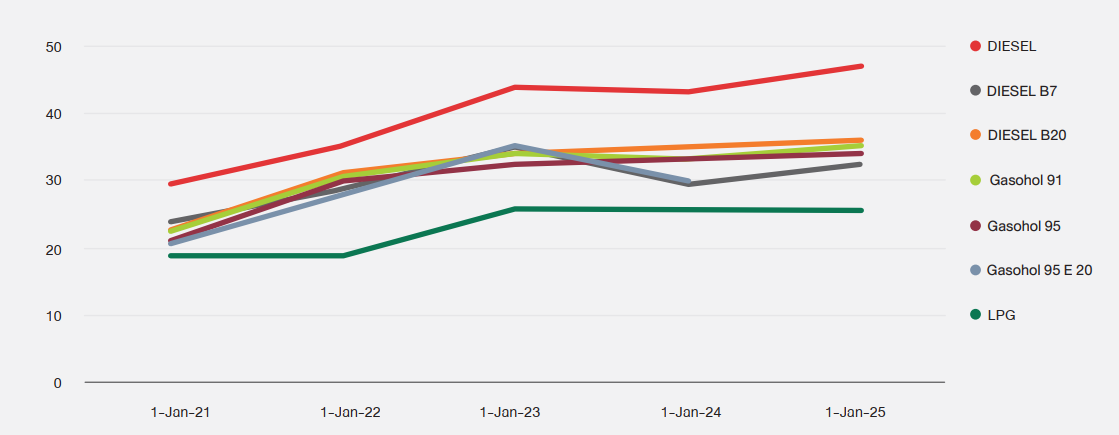
Source: Energy Policy and Planning Office, Ministry of Energy
In 2022, global crude oil prices continued to rise due to several main factors: 1) the ongoing war between Russia and Ukraine, along with the policies of the United States, a major oil producer; 2) the reduction in oil production by OPEC, the major oil-exporting group. In 2020, OPEC cut production by 10 million barrels per day, leading to an oil shortage. Although OPEC gradually increased production multiple times after that, it was still insufficient to meet global oil demand; and 3) the prolonged COVID-19 pandemic, lasting over two years, which caused a downturn in the global economy and trade volume. As the situation began to ease and the economy started recovering, the demand for fuel oil surged beyond production capacity, resulting in a sharp increase in oil prices, which, in turn, led to a rise in the demand for LPG in the automotive sector.
In 2023, despite OPEC's decision to cut oil production, global crude oil prices fell compared to the previous year. This decline was mainly driven by several factors: 1) an increase in oil production from countries outside OPEC, such as the United States, Brazil, and Guyana; 2) geopolitical conflicts and global economic conditions, which negatively impacted oil demand; 3) policies supporting alternative energy sources, which further reduced oil consumption; and 4) the slowdown of the Chinese economy, which led to lower demand for oil. Nevertheless, domestic retail fuel prices remained high, sustaining the demand for LPG in the automotive sector.
In early 2024, oil prices showed an upward trend due to constrained oil supply following the United States’ announcement of new sanctions on Iran’s oil exports, particularly targeting Chinese refineries. In addition, geopolitical uncertainties and production cuts by the Organization of the Petroleum Exporting Countries (OPEC) may further contribute to upward pressure on oil prices. However, several factors may limit significant increases in oil prices. These include the slowdown of the global economy resulting from the impact of U.S. tariff measures and retaliatory trade actions by affected countries, the incomplete recovery of China’s economy, and the expected increase in crude oil production capacity in the United States.
(2) Number of Vehicles Using LPG as Fuel in Thailand
In recent years, the number of vehicles using LPG as fuel in Thailand has been declining. This is primarily due to some vehicles that previously used LPG being taken out of service or discontinued, while others have switched back to gasoline-powered vehicles as retail fuel prices decreased during certain periods (for example, from late 2014 to early 2020). Additionally, some car owners have opted for electric vehicles. By the end of 2020, the number of LPG-powered vehicles stood at 749,033, down from 877,676 at the end of 2019. However, as retail fuel prices rose, the rate of decline in LPG-powered vehicles slowed. The number of vehicles using LPG as fuel was 641,287 by the end of 2021, 589,920 by the end of 2022, 554,262 by the end of 2023, 531,331 by the end of 2024 and 513,130 by the end of 2025.
Number of Vehicles Using LPG as Fuel From End of Year 2021- 2025
2021 | 2022 | 2023 | 2024 | 2025 | |
|---|---|---|---|---|---|
Number (Units) | Number (Units) | Number (Units) | Number (Units) | Number (Units) | |
Number of Vehicles at the End of the Period | |||||
LPG | 17,273 | 16,281 | 15,130 | 14,651 | 14,251 |
LPG and Gasoline | 623,072 | 572,852 | 538,464 | 516,107 | 498,365 |
LPG and Diesel | 942 | 787 | 668 | 573 | 514 |
Total | 641,287 | 589,920 | 554,262 | 531,331 | 513,130 |
Number of Newly Registered Vehicles 2/ | |||||
LPG | 247 | 115 | 225 | 170 | 1 |
LPG and Gasoline | 1,470 | 2,333 | 3,116 | 3,205 | 1,124 |
LPG and Diesel | - | 2 | 6 | 1 | - |
Total | 1,717 | 2,450 | 3,347 | 3,376 | 1,125 |
Number of Vehicles Out of Service 1/ | |||||
LPG | 944 | 1,107 | 1,376 | 649 | 401 |
LPG and Gasoline | 108,229 | 52,553 | 37,504 | 25,562 | 18,866 |
LPG and Diesel | 290 | 157 | 125 | 96 | 59 |
Total | 109,463 | 53,817 | 39,005 | 26,307 | 19,326 |
Source: Transport Statistics Group, Planning Division, Department of Land Transport
Note: 1/ The number of vehicles no longer in use is calculated from the total number of vehicles at the end of the period, along with the number of newly registered vehicles.
2/ In April 2025, the Department of Land Transport recorded only newly registered brand-new vehicles, excluding used vehicles re-registered during the period.
Rising retail oil prices since late 2020, particularly the significant increases observed in 2021 and 2022, encouraged some vehicle users to switch to vehicles capable of using LPG as fuel. As a result, the number of newly registered LPG-fueled vehicles increased from 1,717 units in 2021 to 2,450 units in 2022, 3,347 units in 2023, and 3,376 units in 2024. In 2025, newly registered LPG-fueled vehicles totaled 1,125 units. In addition, elevated retail oil prices prompted some vehicle owners to continue using their existing LPG-fueled vehicles rather than discontinue usage. The number of LPG-fueled vehicles that ceased operation declined significantly from 109,463 units in 2021 to 53,817 units in 2022, 39,005 units in 2023, and 26,307 units in 2024. In 2025, the number of LPG-fueled vehicles that ceased operation totaled 19,326 units, representing a decrease compared to 6,981 units in the same period of the previous year. In addition, considering the cumulative number of registered public passenger vehicles with a seating capacity of not more than seven persons (“Public Hire Vehicles”), which includes taxis—one of the Company’s target customer groups, it is observed that the number of such vehicles using NGV as fuel has continuously declined. The number decreased from 57,363 vehicles at the end of 2021 to 51,111 vehicles at the end of 2022, 44,589 vehicles at the end of 2023, 36,497 vehicles at the end of 2024, and further to 29,959 vehicles at the end of 2025. The decline in the number of NGV-powered public hire vehicles is attributable to several factors. One key factor is the operational limitations associated with NGV as a fuel, such as the longer refueling time compared with LPG or gasoline, and the smaller storage capacity of NGV cylinders installed in vehicles compared with LPG cylinders, which results in shorter driving distances per refueling. As a result, some drivers of NGV-powered public hire vehicles have sought to switch to LPG as an alternative fuel. This trend is consistent with the Company’s “PT Taxi Transform” program, which encourages NGV-powered public hire vehicle drivers to install equipment that enables their vehicles to convert to LPG as fuel. Under this program, the Company provides partial financial support for the equipment installation for participating drivers. Consequently, the number of public hire vehicles using LPG as fuel has shown a generally increasing trend, rising from 24,968 vehicles at the end of 2021 to 29,176 vehicles at the end of 2022, 33,611 vehicles at the end of 2023, and 35,629 vehicles at the end of 2024, before slightly declining to 34,743 vehicles at the end of 2025.
The number of passenger-carrying hire vehicles with a capacity of no more than 7 people that use LPG and NGV as fuel during 2021 to 2025.
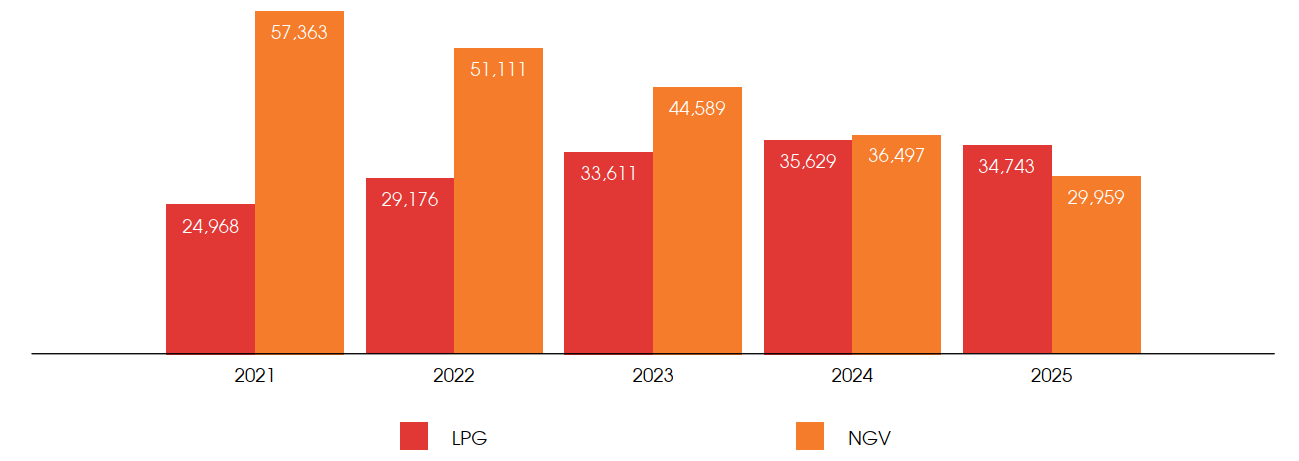
Source: Transportation Statistics Group, Planning Division, Department of Land Transport
(3) Number of Food and Beverage Service Operators in Thailand
Although the COVID-19 outbreak in 2020 adversely affected restaurant and beverage operators in Thailand, the industry has continued to demonstrate growth in recent years. According to data from the Department of Business Development, the number of registered restaurants in its database increased from 330,840 establishments in 2019 to 332,874 establishments in 2020. The figure further rose to 382,037 establishments in 2022, 384,974 establishments in 2023, 388,037 establishments in 2024, and 390,829 establishments in 2025. This continued increase reflects the resilience and adaptability of Thai restaurant operators, as well as sustained consumer demand for dining out. Changing consumer behavior, including a growing preference for eating at restaurants, has been partly supported by the widespread use of social media platforms that actively promote new and trending restaurants. Such exposure has contributed to higher demand, particularly for well-known dining areas across the country.
Statistics on the number of food and beverage service operators during 2021 to 2025.
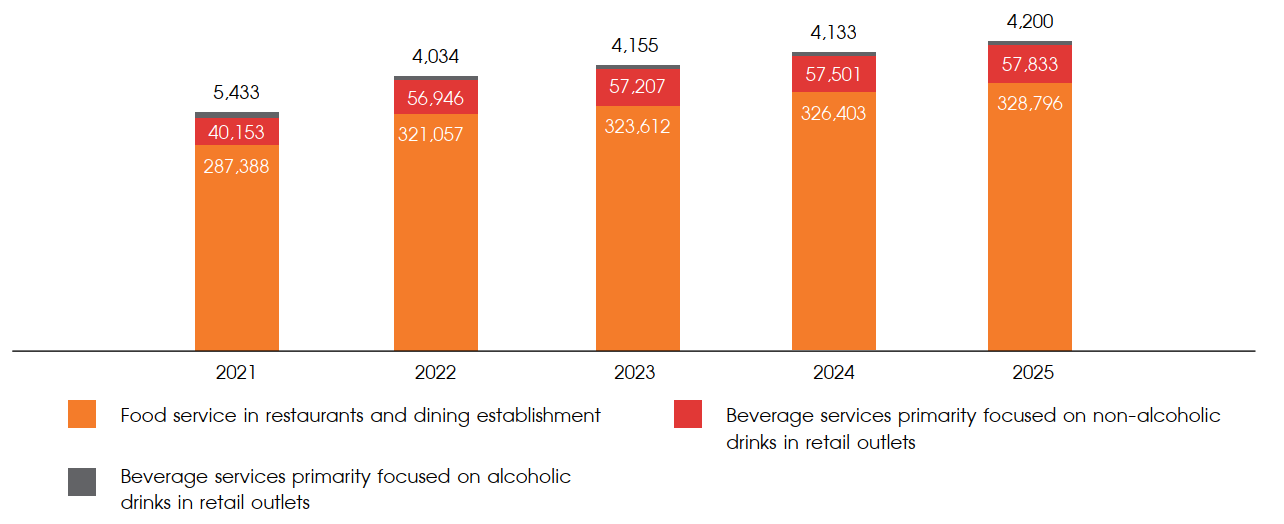
Source: Business data based on the Thailand Standard Industrial Classification (TSIC)
(4) Government Policies
The government has placed significant emphasis on regulating and formulating energy policies to ensure Thailand's long-term energy security. To this end, the government enacted the Energy Industry Act, B.E. 2550 (A.D. 2007), aimed at promoting energy security, improving the efficiency of energy operations, and ensuring fairness for both energy producers and consumers. It also focuses on encouraging the efficient and sustainable use of energy resources within the energy sector. In addition, the government has established various agencies to oversee energy use and procurement in the country, ensuring compliance with established frameworks and guidelines. Notably, the National Energy Policy Council (NEPC) and the Energy Policy and Planning Office (EPPO) were set up to review and propose energy policies and development plans to the Cabinet, as well as to set criteria and conditions for energy pricing that align with the country's energy management and development strategies.
In the past, government energy policies and regulations, along with those from related agencies, have had both positive and negative impacts on the Company's LPG distribution business. Some of these impacts include:
The regulation of the retail price of 15-kilogram LPG cylinders, which are widely used by households and small restaurants, aims to ensure that the price remains affordable for the general public, preventing excessive burdens on their cost of living. During periods when global LPG prices rise significantly, the Energy Policy Administration Committee (EPAC) may decide to provide compensation from the Oil Fund or maintain the ex-refinery LPG price in order to stabilize the retail price of the 15-kilogram LPG cylinder. Alternatively, the committee may opt for gradual price increases to reduce the financial strain on the Oil Fund. Consequently, the implementation of such policies can lead to fluctuations in the Company’s profits from LPG sales, either increasing or decreasing depending on the circumstances.
The determination of the contributions to or compensation from the Oil Fund that operators of natural gas separation plants must pay or receive will be reviewed and adjusted by the Energy Policy Administration Committee (EPAC) based on prevailing price conditions and energy demand at the time. As a result, the implementation of such policies may, at times, affect the cost of LPG sold by the Company.
The determination of the natural gas cost used by gas separation plants in LPG production is designed to maintain appropriate LPG pricing. The National Energy Policy Council (NEPC) has reviewed and set the cost of natural gas used in the petrochemical industry, electricity generation, and gas separation plants to align with current natural gas supply conditions. This cost is based on a weighted average between domestically sourced natural gas and imported natural gas (Pool Gas). However, during periods of rising global energy prices, such as due to the Russia-Ukraine conflict, the NEPC has decided that the cost of natural gas used for LPG production should be based on the price of natural gas from the Gulf of Thailand (Gulf Gas). This decision has helped mitigate a sharp increase in the cost of LPG produced by gas separation plants in line with global market fluctuations. Consequently, such policy changes may, at times, affect the cost of LPG sold by the Company.
Additionally, the government may introduce other non-energy-related measures that could affect the Company's operations. For instance, measures to support the cost of living for low-income groups, such as offering discounts on LPG cylinder prices to beneficiaries of state welfare programs.
Factors Affecting the Demand for Advertising Media on Taxis and at Service Stations
The advertising industry in Thailand has continued to grow steadily. The net value of advertising media was 107,658 million baht in 2020, increasing to 108,776 million baht in 2021, representing a growth of 1.04%. It then rose to 112,713 million baht in 2022, growing by 3.62%. In 2023, the value increased to 116,413 million baht, a growth of 3.28%, and in 2024, it further increased to 117,328 million baht, growing by 0.79%. The growth of the advertising business in Thailand has been supported by retail through e-commerce channels that have increased digital advertising to stimulate sales, as well as the entry of foreign online shopping platforms driving advertising through internet media, out-of-home media, and television media. One of the advertising media that has gained significant popularity recently is Out-of-Home (OOH) advertising, which includes large billboard advertisements, bus advertisements, taxi advertisements, and advertisements on signs in public areas (such as restaurants, service stations, airports, and shopping malls). The net value of out-of-home advertising has increased significantly as a proportion of total net advertising media value, from 11% in 2020 to 16% in 2025. Although out-of-home advertising was affected during the COVID-19 pandemic due to reduced public travel, after the situation returned to normal, various products and services resumed using out-of-home advertising to reach customer groups more effectively. This is because OOH media can target specific audiences, define locations, and create brand recall and confidence in products and services. Additionally, out-of-home advertising can reach large target audiences because such media are typically installed in areas with heavy traffic.
Net advertising media value during the period from 2020 to 2025
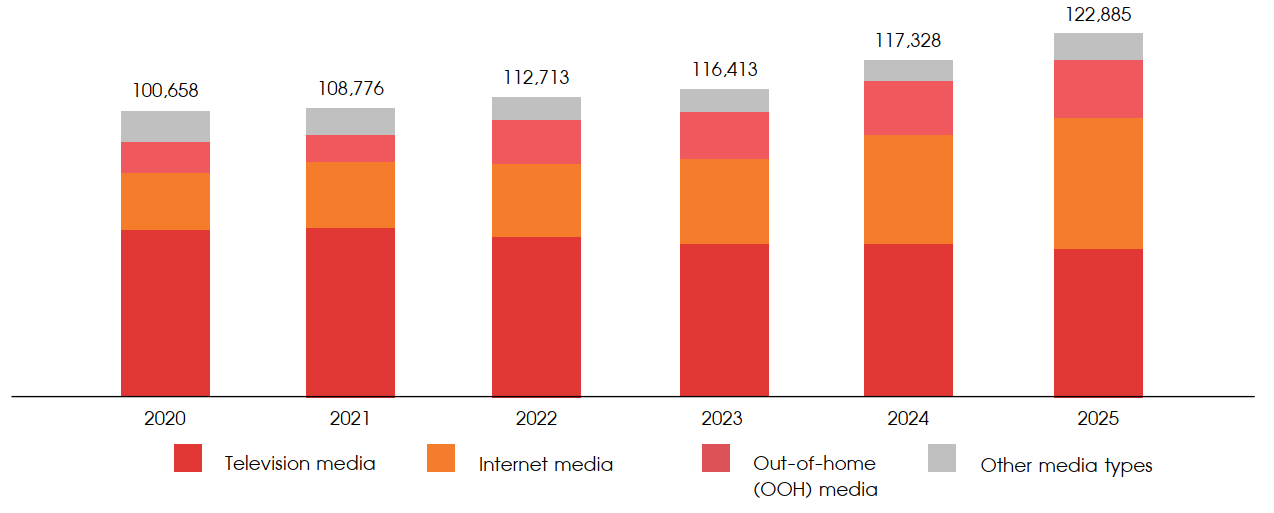
Source: The Nielsen Company (US), LLC., Digital Advertising Association (Thailand)
Procurement of Products & Services
Reporting Mode
3117
Procurement (Overall)
Procurement of LPG
LPG that the Company sells to various user groups is a type of petroleum product obtained from the crude oil refining process or natural gas separation process. Therefore, the Company can procure LPG directly from major Section 7 traders engaged in oil refining and/or natural gas separation businesses (“major LPG traders”). In the past, the Company has entered into LPG purchase agreements with several major gas traders. Since these agreements do not specify a fixed quantity of LPG that the Company must purchase or that the major gas traders must sell, contracting with multiple major gas traders ensures that the Company can continuously source LPG for sale to customers. This mitigates the risk if any one gas trader faces issues affecting LPG production and delivery. When sourcing LPG from contracted major gas traders, the Company and the traders jointly plan LPG procurement in advance to ensure both parties can deliver and receive LPG according to the agreed schedule. The Company provides advance notice of LPG ordering and delivery plans to the traders, who then compare these plans with their LPG production schedules and confirm the procurement plans back to the Company. Additionally, the Company occasionally procures additional LPG from other traders during periods of increased demand. Regarding pricing, the Company and the major gas traders agree to set the LPG purchase price based on the price announced by the Fuel Fund Management Committee, plus agreed additional costs with each trader, and less any discounts specified by each trader.In 2024, the proportion stood at 98.60%, slightly decreasing to 98.47% in 2025.
LPG Transportation
The LPG gas that the Company procures and receives from each major gas trader is primarily transported by gas carrier ships. This is because the main LPG storage facility (“gas terminal”) used by the Company to store LPG purchased from each major gas trader is the “Bangpakong” gas terminal, which is located on a large river suitable for receiving gas shipments by sea. Transporting LPG by ship allows the Company to move large volumes of LPG at one time, ensuring the Company has sufficient LPG supply for sale and delivery to many customers. Additionally, transportation by gas carrier ships results in lower per-unit LPG transportation costs compared to truck transportation over equivalent or similar distances. In the past, the Company has entered into a transportation service contract with a maritime freight service provider (who is not a person with potential conflicts of interest with the Company) to ensure the Company can secure gas carrier ships to receive LPG according to the procurement plans agreed upon with the gas traders. The Company specifies the required vessels and the minimum number of trips to be transported each month. The Company also provides advance notice of LPG delivery schedules to the transportation service provider to prepare for service readiness.
While the transportation of LPG stored at the Company’s gas terminals to the Company’s LPG service stations, LPG filling plants, and gas terminals, as well as the transportation of LPG for delivery to customers, is primarily conducted by LPG tank trucks, the Company has entered into a transportation service agreement with PTG Logistics Co., Ltd. (“PTGLG”), a company wholly owned (100.00%) by PTG. Additionally, the Company has entered into another LPG transportation agreement with a third-party logistics provider (who is not considered a related party or a party with potential conflicts of interest with the Company). Therefore, the Company is confident in its ability to secure a sufficient number of LPG tank trucks to meet its transportation needs. The Company utilizes the services of both logistics providers for LPG transportation by road, taking into consideration various factors that may affect its operations. One key factor is expertise in the transportation of hazardous materials, as a lack of caution or improper conduct by the logistics provider could lead to transportation accidents, resulting in damage to life, property, and the Company's reputation. Another factor considered is the size of the provider’s vehicle fleet. Providers with smaller fleets (i.e., limited number of serviceable trucks) tend to have limited capacity to cover all areas required by the Company and may be unable to supply replacement trucks in case of vehicle unavailability, posing a risk of failure to execute transportation plans as scheduled. Moreover, the complexity of coordinating with multiple logistics providers is also taken into account. Engaging several transportation providers would require the Company to communicate separately with each to confirm transportation readiness on individual routes, which could complicate daily planning and result in operational delays or a lack of flexibility in adjusting transportation plans. As such, the Company has selected two primary transportation providers that both possess large LPG truck fleets and long-standing experience in transporting fuel and LPG to serve as its main LPG transportation providers. Nevertheless, the Company also engages additional LPG road transportation service providers on certain occasions when there is a need to increase transportation volume beyond the planned capacity.
The Company has also entered into a transportation agreement with PTGLG for the delivery of LPG in cylinders. This arrangement covers the transportation of LPG cylinders from the Company’s filling plants to its own LPG outlets, as well as to the dealer’s LPG outlets and commercial customers. Since the transportation of LPG cylinders requires large trucks equipped with specialized equipment for safe handling ("LPG cylinder transport trucks"), each shipment involves significant volumes of LPG. As a result, the Company relies on transport providers with expertise in hazardous materials transportation. However, for smaller shipments of LPG cylinders from the Company’s gas stations to customers, which involve lower volumes, deliveries are made using motorcycles equipped with specialized carriers for LPG cylinders. In these cases, the Company has assigned its own staff at the LPG outlets to personally handle the delivery of LPG cylinders directly to customers.
LPG Storage
To ensure that the Company has a sufficient supply of LPG for distribution, the Company procures and receives large quantities of LPG from each major gas trader. Consequently, the Company is required to store the gas in its gas storage terminals. Thereafter, the LPG is gradually transported to the Company’s LPG service stations and LPG filling plants, as well as delivered to customers. In addition, as the Company is a Type 7 LPG trader engaged in the business of LPG distribution, it has a legal obligation to maintain an LPG reserve in proportion to its annual sales volume (“statutory reserve”). Accordingly, the Company utilizes the services of an LPG storage terminal operator to store both the LPG intended for sale and the statutory reserve. Using outsourced LPG storage services helps reduce the Company’s burden of investing in its own gas storage infrastructure. Moreover, the storage terminal is located adjacent to a river and equipped with a port for marine LPG loading and unloading, making it suitable for the Company’s operations, which emphasize LPG procurement and transportation via gas carriers. (Further details regarding the terms and conditions of the LPG storage terminal lease agreement can be found in Section 1. Business Operations and Operating Results, Item 5.2.3 Summary of Key Agreements Under Item 12) LPG Depot Lease Agreement.)
However, to support the expansion of its LPG distribution business to cover a broader range of areas, the Company has invested in and commenced operations of LPG storage terminals that are managed by the Company (“the Company’s LPG terminals”) in various regions. Investment in the Company’s LPG terminals enables the Company to transport LPG by truck to distribute and store LPG in different areas with high demand. As a result, the Company is able to maintain an adequate LPG supply for distribution to target customers located near the Company’s LPG terminals. In addition, the Company also utilizes the LPG storage services of another LPG terminal operator to store the statutory LPG reserve, which has increased in line with the continuous growth in the Company’s sales volume in recent periods. The LPG terminals currently used by the Company in its operations (including both the Company’s own terminals and third-party storage terminals) are detailed as follows:
Location | Capacity | Usage Characteristics2/ | |
|---|---|---|---|
| Bang Pakong District, Chachoengsao Province | 10,000 tons | Storage of LPG for sale and for statutory reserve |
| Wachirabarami District, Phichit Province | 1,000 tons | Storage of LPG for sale and for statutory reserve |
| Sawang Wirawong District, Ubon Ratchathani Province | 400 tons | Storage of LPG for sale and for statutory reserve |
| Mueang Samut Songkhram District, Samut Songkhram Province | 400 tons | Storage for statutory reserve |
Note: 1/ Approximate maximum capacity agreed upon between the Company and the LPG storage terminal service provider.
2/ In the future, the Company may revise the usage of certain LPG terminals to store either LPG for sale or statutory reserve only. Such changes will be made at the Company’s discretion, with primary consideration given to the appropriateness and efficiency of business operations.
For the LPG stored with third-party LPG storage terminal operators, the Company requires that personnel from the LPG procurement department (Supply Chain) verify the accuracy of the remaining gas quantity, as reported in the daily LPG inventory movement reports submitted by the storage service providers. These reports are compared against the Company’s own gas receipt and dispatch data, based on the actual gas transfer documents generated each day. Additionally, the Company mandates that personnel from the LPG procurement department (Supply Chain), together with the accounting department, conduct physical inspections of the remaining LPG inventory at the storage terminals and prepare monthly inspection reports. Moreover, the Department of Energy Business conducts random inspections of the statutory LPG reserve approximately two to three times per year. The Company uses the LPG quantities stated in the Department’s inspection reports to verify against the Company’s own records and the data provided by the storage service providers. As the Company’s LPG sales volume continues to grow, the need for increased LPG storage also rises. If the Company intends to store additional LPG with a storage service provider, it plans to lease full gas storage tanks (as each storage terminal typically consists of multiple tanks). This would ensure that the LPG stored in those tanks is exclusively owned by the Company, enabling the Company to maintain full control over its stored LPG and to verify the remaining quantities with complete accuracy.
LPG Cylinder Filling
The liquefied petroleum gas (LPG) cylinders sold by the Company at its own gas retail outlets and distributed to the gas retail outlets of its authorized dealers as well as to commercial customers are filled at the Company’s LPG filling plants. The LPG filling process at the plant begins with the transportation of LPG (commonly referred to as "cooking gas") that the Company has procured and stored in large LPG storage tanks (“bulk reserve tanks”) located within the LPG filling plant. In parallel, empty LPG cylinders collected from the Company’s own retail gas outlets, the retail outlets of authorized dealers, and commercial customers are transported back to the Company’s filling plant. Before the filling process begins, the staff at the filling plant clean the LPG cylinders, inspect their condition, and separate out any cylinders that are deemed unfit for use or due for scheduled inspection and maintenance in accordance with legal requirements. When the gas-filling staff carry out the process of filling LPG into the cylinders, the LPG stored in the bulk reserve tanks is transferred through the internal pipeline system of the filling plant to the filling nozzles located inside the gas filling building. The greater the number of filling nozzles at the LPG filling plant, the more cylinders—of various sizes—can be filled with LPG simultaneously. The gas-filling staff inspect the results of each cylinder filling operation, including checking for gas leaks and verifying the accuracy of the quantity of gas filled. Afterward, the filled LPG cylinders are moved by the gas-filling staff to the storage yard within the filling plant, where they are prepared for delivery. The Company delivers filled LPG cylinders using large trucks equipped with the necessary tools and equipment suited for transporting LPG cylinders (“LPG Cylinder Transport Trucks”). When an LPG cylinder transport truck arrives at the Company’s filling plant, the plant staff coordinate with the driver to load the appropriate number and sizes of LPG cylinders to be delivered on that trip. Upon arrival at the destination, the transport staff unload the filled LPG cylinders and deliver them to the Company’s gas retail outlets, authorized dealer outlets, and commercial customers. Subsequently, the transport staff collect the empty cylinders (“empty cylinders”) from the Company’s gas retail outlets, authorized dealer outlets, and commercial customers—where the cylinders have already been used—and load them onto the truck for return to the Company’s filling plant to be refilled. The Company’s currently operating LPG filling plants, as well as additional plants to be opened, are detailed as follows:
Filling Plant | Location | Maximum Compression Capacity |
|---|---|---|
| Ratburana District, Bangkok | 1,600 tons/month |
| Makham District, Chanthaburi Province | 350 tons/month |
| Ban Chang District, Rayong Province | 2,000 tons/month |
| Kabinburi District, Prachinburi Province | 1,200 tons/month |
| Thanyaburi District, Pathum Thani Province | 1,200 tons/month |
| Pabon District, Phatthalung Province | 1,500 tons/month |
| Wachirabarami District, Phichit Province | 1,200 tons/month |
| Khao Yoi District, Phetchaburi Province | 2,000 tons/month |
| Mae Prik District, Lampang Province | 1,500 tons/month |
The Company also stipulates the repair of LPG cylinders that are used in rotation by each dealer’s filling plant in the course of their business operations. Under the dealer appointment agreement for LPG filling plant-type dealers, it is specified that the Company shall be responsible for the maintenance and repair of LPG cylinders to ensure they remain in usable condition and comply with legal requirements, which mandate inspection of gas cylinders every five years. The Company requires each dealer to collect the LPG cylinders that are due for repair or scheduled for inspection, and to notify the Company of their intention to have such cylinders repaired and inspected. Once the dealer delivers the identified LPG cylinders to the Company for repair, the Company will provide replacement LPG cylinders to the dealer so that the dealer can continue its filling operations without interruption.
5. Procurement of LPG Cylinders
To operate its LPG distribution business for households, the Company requires LPG cylinders for filling with gas ("Cooking Gas") to supply both household customers and commercial clients. The Company has signed a contract to purchase ready-to-use, empty LPG cylinders from a domestic manufacturer, a major supplier within the country, ensuring a reliable and adequate supply of cylinders for the Company’s operations. In procuring these cylinders, the Company will assess future demand, considering the required quantities of cylinders in various sizes to meet the anticipated sales of filled LPG cylinders over the next year. Additionally, the Company will forecast when the need for more cylinders will arise. Based on this evaluation, the Company will collaborate with the manufacturer to prepare for production and delivery. The Company will issue purchase orders incrementally, specifying the types and quantities of cylinders needed, and will provide a deposit based on the value of each order placed.
Raw Material Acquisition (Overall)
-
Production Policy (Overall)
-
Distributors (Overall)
-
Number of Raw-Material Distributors (Overall)
0
Production Capacity (Overall)
| Item | Unit | Unit (if Other) | Used | Capacity |
|---|---|---|---|---|
| - | Others | - | 0 | 0 |
Domestic/Overseas Purchase Proportion (Overall)
| Raw Material | Source Country | Value |
|---|---|---|
| - | Other | 0 |
Product Information — Overview
Introduction
Product Characteristics
At present, the Company’s principal product is Liquefied Petroleum Gas (Liquefied Petroleum Gas: LPG) (“LPG”), which is a mixture of two types of hydrocarbons, namely butane and propane. LPG has key characteristics including its flammability and high calorific value, making it widely used as a fuel in both the household and industrial sectors. In the household sector, LPG is commonly used as a fuel for cooking, water heating, and clothes drying. In the industrial sector, LPG is used as a fuel for operating forklifts and other machinery, as well as in manufacturing processes that require high heat, such as the production of glass, ceramics, and steel. In addition, LPG can also be used as a feedstock in the chemical industry.
Projects Under Construction
Has Projects Under Construction (Y/N)
No
Debentures & Bills of Exchange
Has Debentures (Y/N)
No
Convertible Securities
Has Convertible Securities (Y/N)
No